
This review is based off my plays on Board Game Arena. If I play it in person in the future and my opinions change, I’ll be sure to amend this review.
I’m a sucker for a good theme, and there are few themes that connect with me better than Movie theatres. Back in my early adulthood, a combination of sudden disposable income and lack of post secondary educational prospects, I saw almost every movie that hit the theatres that summer. Popcorn, designed by Maxime Demeyere and published by Iello, embraces the theme of running your own movie theatre, complete with spoof-filled movie posters, and I’m here for it.
Even before I knew how it played, I wanted to play it. When it popped up on Board Game Arena, the cartoon art and cheeky parodies of blockbuster films had me grinning before I’d even looked at the rules. At its heart, Popcorn is about efficiency through bag-building. You start with a small mix of generic and coloured meeples, who make up your initial offering of loyal moviegoers. Each round, you’ll draw from your bag, fill your seats, and activate bonuses from both the seats and the movies, if you manage to get the colours to sync up. Those bonuses will see you earning coins, hooking new customers, and popping the titular popcorn, which count as victory points.
The gameplay loop is simple but satisfying. During the pre-show phase, you can buy new movies to fill your theatres, replace the seats in your three theatres, and activate promotion tokens, which allow you to fill your bag with more meeples, either from the supply, or directly from your opponent’s discard piles. During the movie phase, you assign your meeples to seats, then activate each theatre, getting the bonuses I described above. After nine rounds, the player with the most popcorn wins, with bonus awards for everyone’s secret award cards, and some bonus points for the player who spent the most money on their theatre.

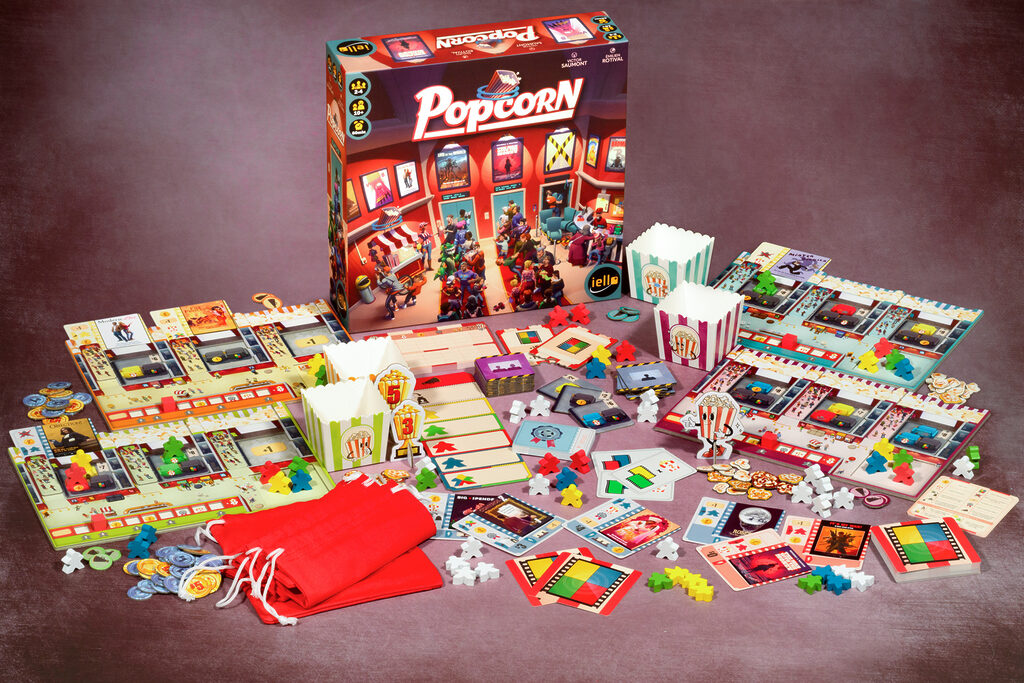
Image taken from Iello’s website
One mechanic that I found interesting was that in-between your showings, your movies slowly expire. You slide a little audience token up the side of the movie, covering actions from the bottom up. This encourages you to swap out an old film to keep your theatre humming.
Also in-between the showings is your chance to buy one new film and one set of new seats for your theatre. The markets here are quite limited, 6 total films, and 9 seats. If the colours or actions you’re desperately seeking after one of your shows has it’s actions exhausted by time doesn’t show up, you’re really up the creek without a paddle.
Popcorn sits comfortably in the “light euro” category, generally rewarding good planning but never really punishing you for making a mistake or taking a slight gamble. The obvious star of the show is the bag building mechanic, which I’ve been a fan of every time I see it employed (see Automobiles and Orleans). In Popcorn, the bag building represents you curating your audience, trying to lean into one of the genres to maximize the number of actions you get during every showing. Of course, randomness plays a major role. A bad draw at the wrong time can kneecap your plans, leaving you poor going into a new round while your movies are quickly expiring. For players who prefer full control in their euros, that unpredictability may be a deal-breaker.
For a light euro game, Popcorn does have a surprising streak of mean-spiritedness. When the visitor supply runs out, players can “borrow” guests from each other’s theatres. And I say borrow, but the reality is that you’re wholesale stealing them. Likewise, if you draft last in a round, the options for new movies might be slim pickings, but at least the rotating first-player marker keeps things fair across the session.
That said, the luck factor is real. Money is tight, and one of my plays taught me that if you run out of cash, and don’t have a seat power to generate some, you are effectively out of the game. The award cards, while perhaps adding some replayability, can feel uneven. Some are straightforward and lead into natural engines, while others depend on some lucky draws or specific combination of theatres and guests. And while the shared market of films makes for fun tension, it does mean turn order can be everything. Sitting late in a round often means your best-laid plans are eaten alive by hate-drafting opponents.

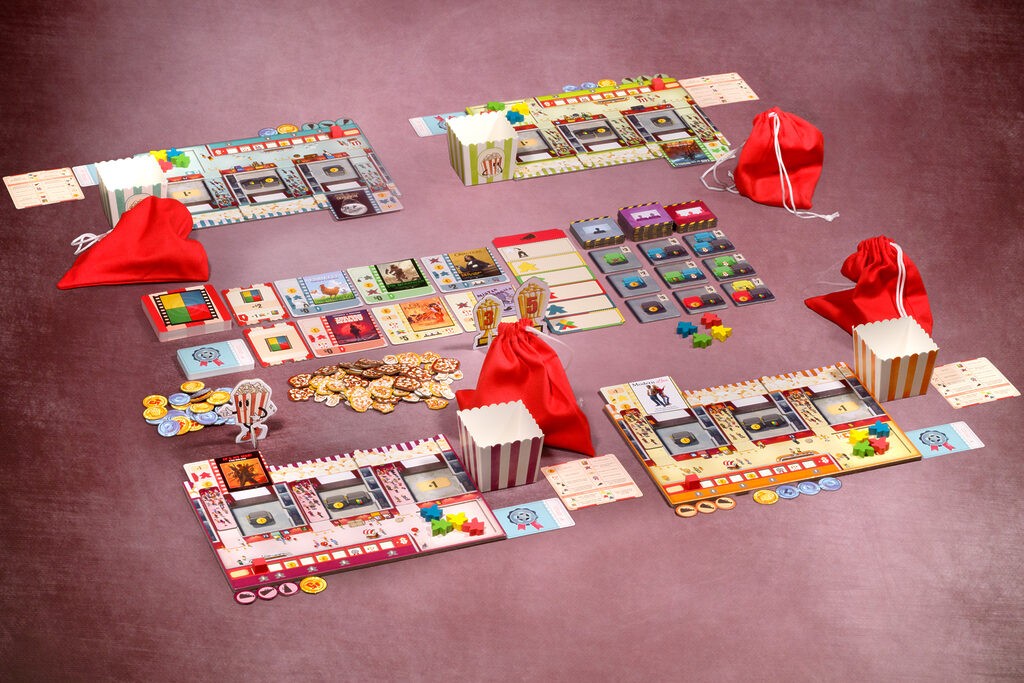
Image taken from Iello’s website
Whatever mechanical complaints might exist, Popcorn nails its presentation. The artwork is an absolute standout, every movie card is a spoof of a real blockbuster, complete with witty taglines and tongue-in-cheek flavour text. Looking at pictures and videos of the physical production, The components themselves are just as charming. The first player token, a vintage popcorn bucket character that looks pulled right from the Steamboat Willy era of animation, is thematic perfection. The dual-layer theatre boards look to keep everything stable, and each player gets their own charming popcorn bucket to store their victory points.
There’s a sweetness to Popcorn that reminds me of games like Quacks of Quedlinburg or Cubitos. It’s light, colourful, and just a little bit unruly. You can teach it in five minutes, play it in an hour, and still have room for dessert afterward. But perhaps a bit like empty calories, while it was satisfying in the moment, there was little of substance that made me want to come back. Many modern euro games are great to play once, and I feel that Popcorn is one of those examples. It looks and plays great the first time you get it to the table, but there’s little there to pull me back in. The variability in gameplay comes from the movie market and award cards. The game feels the same every single time, and there’s precious little in the way of system mastery to be explored here. Just, hope the luck plays out in your favour.
Popcorn is the perfect game to play at a board game café. It has some clever ideas that are fun to explore, great humour in the cards, and the game doesn’t overstay it’s welcome. It doesn’t reinvent the bag-building mechanism, but it does manage to feel fresh right out of the box. It’s a good game to play once, especially if you have a particular fondness for the cinema.


0 Comments