I adore Lost Cities. It’s the perfect 2 player game for my wife and I. Competitive without being directly mean, random enough to make your risks feel like you’ve hit the lottery if you win, but also don’t really feel too bad if they don’t pan out, and I end up with a bucket of negative points. In my opinion, it’s my favourite game designed by Renier Kenizia. What I didn’t know until somewhat recently was that in the same year that Lost Cities came out, Schotten Totten was also released. Schotten Totten has players manage a hand of cards, playing them to your side of a line, trying to claim control of either the majority of the spaces, or three consecutive spaces. From an abstract view, it’s pretty comparable to Lost Cities, but when it comes to how the games feel, they couldn’t be more different.
A deck of Schotten Totten consists of 54 cards, numbered 1 to 9 in six different colours, and 9 stone tokens. The stone tokens are laid out in a line between the players, the deck is shuffled, and each player is dealt 6 cards. On your turn, you play a card to any of the 9 stones, and then draw a card to replace the one you just played. Any card can go on your side of any stone, but each stone has a capacity of 3 cards per side. Once a stone is full, it’s evaluated, and whoever has the stronger showing on their side of the stone claims it for themselves.
The strength of your side is determined by which cards you put on your half of the stone. A colour run is the strongest, 3 consecutive cards of the same colour. Then, three of a kind is the next strongest, 3 cards of the same value. Then any flush, three cards of the same colour, then a run, 3 consecutive cards of any colour, and finally, a sum. 3 non-consecutive cards of different colours.
Schotten Totten is a masterclass in tension in a 2 player game. It’s incredibly tactical, as you only have access to 6 cards at a time, the likelihood of you drawing a run or flush is fairly low. This forces the player to place cards and hedge their bets that the next card they need is going to show itself eventually. At the start of the game, you’ll place a card here and there, but before you know it, suddenly every card you play is starting to remove options from the future. You have to play a card, but doing so might mean closing off the opportunity for a run on a particular stone. Using a red 5 for three of a kind on one stone means the red 3 that was waiting for the red 4 to show up might end up being a weaker plain red flush instead of the powerful flush run you were hoping for. Before when the 9 stones looked like a wide open field, suddenly the battle line has become clogged and claustrophobic.
One way you can put the screws to your opponent even harder, is if you can prove that there is no way for your opponent to win a stone from you. Say you have three of a kind on your side, and your opponent has a yellow 9 and grey 8. All 3 of a kinds beat all runs, so you can just claim that spot as your own. Not only does that add to your victory conditions, but it also removes a potential schluff spot from your opponent, as once a stone has been called, you can’t play any more cards to that stone. Now, if they need to burn a card from their hand as they search the deck for cards they actually want, they’re going to have to make further sacrifices on their other stones.
For all its tactical brilliance and excitement, Schotten Totten feels quite a bit more confrontational than Lost Cities. In Lost Cities, it’s possible for both players to come out positively on a single colour, should they both choose to chase that suit. Schotten Totten is a zero-sum game. In order for you to win territory, your opponent has to lose it. And honestly, that just feels bad. It’s the kind of bad feelings that makes me not want to play a game with certain players, such as my spouse. I realize that the reasons I prefer Lost Cities will be the same reasons that someone else with slightly different proclivities will prefer Schotten Totten.
Schotten Totten is a great game, but it’s a great game that demands a certain temperament. It thrives on denial, pressure, and the quiet cruelty of watching your opponent’s options evaporate one card at a time. For players who relish that kind of direct confrontation, it’s a masterclass in tight, tactical design that has aged remarkably well and that perfect package of endlessly replayable in a real small box.
For me, though, I’ll always reach for Lost Cities first. I value the tension of risking points without the discomfort of taking something away from the person across the table, especially when that person is my wife. That preference doesn’t diminish what Schotten Totten accomplishes; if anything, it highlights just how precisely it delivers its intended experience. Nearly three decades on, few two-player card games generate as much sustained drama from such a small deck. Schotten Totten knows exactly what it is, and for the right pair of players, it’s pure tactical perfection.
A copy of Maul Peak was provided by the publisher for review purposes.
The 2 player game field is a crowded one. From all the excellent Duel games (7 Wonders Duel, Splendor Duel, Dorfromantik: The Duel, and so many more) to the excellent 2 player games not based on multiplayer games (Lost Cities, boop, Santorini, Hive, Fox in the Forest, and so much more). And this isn’t even getting into multiplayer games that simply play excellently with only 2 players, it makes any 2 player only game have some stiff competition when vying for shelf and table space.
Maul Peak is the stand-alone sequel to Skulk Hollow, both designed by Eduardo Baraf and Keith Matejka. with art by Dustin Foust, Sebastian Koziner, and Helen Zhu, and published by Pencil First Games. In Maul Peak, one player takes on the role of the Grizzars, a tribe of bears with various abilities, while the other player takes on the role of a titan. A towering behemoth, emerging from its lair to lay waste to the land. Feeding into the asymmetry, Maul Peak features 4 different titans to play as, each one having their own abilities, victory conditions, and maps for the Grizzars to climb on. Not to mention an excellently sculpted giant wooden token, unique to each titan.
A druid and its spirit companion face off against Sabaso
The gameplay is simple. One player takes actions (usually by playing a card) until they’ve reached their action limit. They draw new cards and the other player does pretty much the same. Most of the actions each player can do is based on the cards they have in their hand. For the Grizzars, the cards will have you moving on the 3×3 map, leaping from the ground onto the monster (moving your meeple from the ground map onto the titan map), preforming melee attacks to damage the beast, and gaining rage tokens, which can be used in a myriad of ways, but perhaps most importantly, for summoning more Grizzars to the battlefield.
The titans, on the other hand, are much more varied. Saboso freezes characters, and can imprision them within his chest. The giant spider Veblyn lays webs, forcing the Grizzars to discard cards to escape her sticky traps. Quagra is a four-headed hydra who turns the Grizzars against themselves. Each of these titans have their own, unique decks of cards, and force the Grizzar player to adapt their strategy based on the monster they’re facing.
The goal for both players is to defeat the other, by either fully damaging every appendage of the titan, or wiping the map of all Grizzar tokens, although the titans do have an extra win condition, unique to the titan that you’re playing as. The variability is impressive, as the four titans all feel like different challenges to overcome, and you can and should swap sides to experience each titan from both sides of the conflict. If you happen to own Skulk Hollow too, then it’s exponentailly more variable, as the Grizzars can take on the titans from Skulk Hollow, and these beasts can challenge the Foxen too.
I personally found the rulebook a little hard to get through. There were these helpful little boxes all over the pages letting you know how Maul Peak differs from Skulk Hollow, which I imagine would have been incredibly useful, if I were at all familiar with that game. But i wasn’t so I kept on stumbling over the boxes and ended up with several rule questions as I sat down to my first game. There was enough ambiguity to cause confusion, which is a shame for a game as rules-light as this. I will say that once we got through that initial learning curve, the gameplay was pretty smooth. Take your actions, pass to the other player. They take their actions, play passes back to you.
Maul Peak is much more tactical than strategic. What you can do is heavily limited by the cards you have in your hand. There are moments where you have a window of opportunity to further your objective, but if you aren’t holding the right card, you might just be up the creek without a paddle. The titan player starts off intimidatingly powerful, but once a Grizzar starts putting a dent into some of its abilities, as once you fill a titan appendage with blue hearts, they can no longer use the associated ability, suddenly the titan’s deck is full of dead cards.
There are lots of moments in Maul Peak that feel like a war of attrition. Saboso deals one damage to the bears. The bears leap, leap, and do a melee action for one damage. Saboso wacks the bear off, dealing one more damage. The bears summon a new character with a full health bar, leap up and damage Saboso for 2, disabling its whack ability. Saboso mends the whack ability and then whacks the bear off, dealing one more damage. Again, it’s tactical, if you have the cards you need, you can slowly progress your goals, as can the other player. I rarely felt like there were a ton of choices to be had, though, as the optimal option was often very apparent. After a couple of rounds like the one above, the turn to turn gameplay can feel very repetitive.
It is exciting, as the game comes to a close, however. If you’re down to one bear token left, and the titan has a mere two hearts remaining. Who will draw the correct cards first? Did you make the right call to destroy the grey bear earlier in the game, or should you have smote the green one from the map instead? The decision you made 15 minutes ago has suddenly come back to bite you in the butt.
If he can’t whack me, I’m safe on his body!
Maul Peak is a good game, even if it doesn’t quite muscle its way to the front of an already crowded two-player shelf. Its production is excellent: the titan meeples are striking table presences, the artwork sells both menace and personality, and the Grizzars’ Brother Bear meets fantasy adventuring party vibe is oddly charming. The asymmetry is the real hook here, and the four titans do a lot of heavy lifting in keeping the experience fresh, especially if you’re willing to swap sides and see how differently each matchup plays out.
That said, Maul Peak is a fairly simple, highly tactical affair. Your options are often wholly dictated by the cards in your hand, and while the push and pull of attrition can be tense at times, it can also drift into repetition once you’ve seen the core loop a few times. Still, at around 45 minutes, it rarely overstays its welcome, and its straightforward rules makes it an approachable entry point into asymmetric conflict games. If you’re looking for a beautifully produced, head-to-head duel that emphasizes short term adaptation over long-term planning, Maul Peak is well worth the climb.
Every so often, a game comes along that defies expectation. Upon first encounter, you’ll think, “that’s it? What’s even the point?”. You’ll try to hide your skepticism, as some people call it genius. The Mind is one of those games. It’s a cooperative card game, but it feels more like a social experiment. It’s part telepathy, part tension, part collective panic attack. And somehow, it’s wonderful.
I remember hearing about The Mind after it’s first debut at Essen. All the reviewers and podcasts I listened to were raving about this game. I looked up the rules and thought I must have the wrong game. The rules could fit on a bar napkin. Everyone gets a few cards numbered 1–100, and you all need to play them in ascending order. The catch? No talking. No hints, no gestures, no eyebrow wiggles (at least not intentionally). You just… feel when it’s your turn. It sounds laughably thin. In the abstract, you’re silently sorting cards. It sure doesn’t sound engaging.
But then when you do engage with the game, some magic builds. After that first awkward round of silent hesitation, people start to tune in to each other. A rhythm emerges. The tension builds. Someone slowly reaches for their card, and everyone collectively holds their breath. The player moves slowly, thinking, “There’s an 18 on the table and I have a 38. Surely someone else has to have something in between?”. But when it’s right, the entire table exhales in relief. When it’s wrong by one number, the groans are primal.
We recently brought The Mind to my brother-in-law’s place for Christmas, where it became an instant hit. Within minutes, the quiet kitchen table was full of screams. Joy, frustration, triumph, defeat, all wrapped together. We’d cheer like we’d won the Stanley Cup if we managed a perfect round, and howl when we lost by just two cards one point apart. There was one holdout, however. My brother-in-law had wandered by, scoffed, and dismissed the idea out of hand. His wife tried to explain the rules, and he waved it off: “Well, it’s obvious, isn’t it? Just think high and count backwards until you play your card.” “If it’s so easy, join in!” we challenged.
Two hands later, he was laughing harder than the rest of us. The Mind has that power, it turns skeptics into believers.
It’s also one of the funniest unintentional comedy games I’ve ever played. Once, we were playing with someone who was a little too stoned. Everyone sat in perfect concentration, waiting for their moment to strike. The inebriated person played their 30. A pause. Then, they played the 36. Another pause, eye contact. Then they played the 40. Then they looked at the last card in their hand and said, “Oh no. I have the 38 in my hand.” We completely fell apart laughing. It killed the round, but nobody cared, moments like that are the whole point of playing games.
For me, that’s why The Mind works where so many bigger games don’t. It’s not about the cards, or the rules, or proving your mental superiority. It’s about the people. It’s about reading micro-reactions, guessing intentions, and celebrating failure as much as success. Somehow, sorting a 100 card deck creates pure drama. You don’t play The Mind for strategy. You play it for the shared silence, the tension, and the explosion of laughter when someone ruins everything.
Not everyone will love it. We tried to introduce it to one player, and he just absolutely did not get it. Didn’t get the concept, didn’t get the rules, completely fumbled at the lack of structure. It turns out that some people will hate the vagueness or feel silly “concentrating” at the start of each round. That’s fine. The Mind only truly sings when everyone at the table buys in. But when it clicks, it’s magic.
It’s hard to argue with the idea that board gaming is in a golden age right now. Walk into almost any game store, browse an online retailer, or sit down at a local café, and you’re spoiled for choice in a way that simply didn’t exist 15 or 20 years ago. Some people may argue that the real golden age of board games was 10 years ago, when some of the best games of all time were being released, but I’d argue that the reason why the previous decade seemed better than now has more to do with our overconsumption of media and increased awareness of the average game coming out now, rather than an actual quality difference. It’s not unlike when someone says “movies used to be so much better”, and then list only the best movies from a decade. All the chaff has been lost to time, it’s not that the movies used to be better, but we just remember the good ones.
So many games, so much better
I’ll obviously concede that the raw number of new games has increased dramatically over the past 20 years, but I honestly believe that the average game has gotten better. Designers have spent decades iterating, seeing the mechanisms that work, discarding the bits that don’t, and “firing” older designs with cleaner, more engaging versions that make it hard to go back.
Production quality has quietly reset expectations: distinct art styles, thoughtful graphic design, and gorgeous components that almost always meet a solid baseline of quality. The average game released today would be considered an ultra deluxe edition 15 years ago. Just look at Agricola’s original printing, where all the animals are just coloured discs. No stickers, no ani-meeples, no screen printing. Just piles of wooden discs and cubes.
Behold my sheep pen
That is why this era feels like a golden age: you can pick almost any weight or genre and find multiple polished options that didn’t exist 15 years ago. Even mid‑tier releases tend to be well-developed, thoroughly playtested, and perhaps most importantly, look amazing.
I think one of the concepts that people who say that the golden age of board gaming is over needs to reconcile, is the fact that anyone who joined the board game hobby in the last 5 or 10 years, had a period of explosive interest. Every game mechanic was new and interesting, and you had two decades of great titles to plumb. But once you’ve discovered all the greats, your attention naturally shifts to what’s coming out now, and you’re seeing a lot more of the average game, that will eventually be forgotten to time. For example, around 2008 saw the release of Pandemic, Brass, and Agricola. But for all their acclaim, how many people even remember some of the mid-range releases, such as Steel Driver, Shanghaien, or Comuni?
Crowdfunding: fuel and friction
I’d argue that Crowdfunding is the single biggest accelerant behind the glut of new titles, but it also embodies many of the hobby’s current risks. For established publishers, it has morphed from a funding lifeline for games that wouldn’t exist otherwise, into a marketing and pre‑pay/pre-order machine, complete with built‑in hype, and moving the risk from the publisher onto the customers.
The “indie dream” of Kickstarter is shrinking, as players are increasingly less likely to pay attention to, and more importantly, less likely to contribute their dollars to projects that aren’t 1) fully conceptualized and ready to produce, and 2) from a known designer or publisher. Players instead concentrate on the brands that have massive advertising budgets, recognizable designers, and more commonly, a licensed IP. All this leaves unknown designers struggling to fund without already having a platform and/or a huge following.
At the same time, crowdfunding has enabled some amazing projects that might never have existed in a purely traditional system. Games that the designer believed in when no publisher was willing to take on the risk of producing it. The hard question is whether a few unicorns justify a culture of compulsive backing when there are already thousands of proven games on shelves today. Why should you as a consumer take the risk on a Crowdfunded game and put your money down months if not years in advance, when you could pop into your friendly local game store today and buy dozens of known, great games?
Culture, venues, and the next wave of players
On the subject of FLGS, outside the bubble that is this hobby’s media sphere, board games are more visible and normal than they used to be. Wingspan shows up at family gatherings for people who have never heard the phrase “hobby board game,” Ticket to Ride appeared on Saturday Night Live, and big‑box retailers are stocking titles that you used to have to special order.
The small city where I live has grown to support 3 separate board game cafés, and each one is frequently full. Almost every pub around me has a game shelf, and more often than not I see someone plopping one of those games onto the table to have a good time while enjoying their beverages. Libraries are getting in on the action, allowing players to take games home to explore, spreading the board gaming joy to a dozen families at a time. While anecdotal, all of this showcases that board gaming is becoming much more normalized as a default night‑out option rather than a niche pastime.
The most important shift may be generational. Many of the people entering the hobby now are in high school, college, or young adulthood, and they are growing up with modern designs as a normal social activity rather than a discovery. That cohort is likely to carry board gaming forward as one of their default ways to spend time together, and eventually to introduce their own kids to it.
Real risks: AI art, waste, and buying instead of playing
For all of my optimism, there are genuine threats that could flatten or sour the current board game trajectory if left unchecked.
AI art creep: Generative art is cheap and fast, which makes it tempting for publishers looking to cut costs or hit tight schedules. Over time, that will sand off the unique voices that made modern board game art so exciting, replacing distinctive illustrators with a bland, derivative style.
Wasteful production: Giant boxes full of plastic minis and single‑use packaging represent real environmental and storage costs, especially when many of those games see only a handful of plays before being sold or shelved. Every time I feel like this trend is starting to wane, another massive crowdfunding campaign shows up, earns 8 million bucks, and proves me wrong.
Volume over depth: There is a strong temptation, for players and publishers, to treat games as collectibles first and experiences second. Case in point being Queen Games’ Stefan Feld City Collection. When shelves fill faster than tables, good designs get buried, and the market rewards hype cycles and derivative games based on existing products more than replayable, unique and interesting systems.
None of these risks are inevitable outcomes. They are responses to incentives, and incentives can change.
How this golden age becomes a foundation, not a peak
If there is a single lever that would improve the hobby from here, it’s a shift in how players relate to their collections. I want to see more playing, less impulse buying. I feel like higher prices that reflect real development and production costs would likely slow down mindless accumulation and make each purchase feel more like a deliberate commitment to something that will actually hit the table, but we’ve all see the discourse around Food Chain Magnate, and how it’s art and components don’t justify it’s $120 price tag, despite it being one of the best games ever made.
I think it looks beautiful, just the way it is.
Proselytize tactfully: invite people in, show them genuinely great games on their first contact, and normalize board gaming the way golf or live music is normalized. Don’t trick someone into coming to your place only to slam down Arcsand trap them in an hour-long rule tutorial ahead of a 4-hour play time.
Vote with your wallet: reward publishers who pay human artists, design thoughtful, replayable games, and avoid wasteful components; starve the projects that lean on AI shortcuts, plastic bloat, and shallow design. Even if they’re using your favourite IP as a vehicle to suck money out of your wallet.
From that vantage point, this moment or golden age, is less “the top” and more of a mature plateau. This is a time when the board game hobby is big enough to be visible, diverse enough to satisfy nearly any taste, but still flexible enough to be shaped by the people who care about it.
This review is based off my plays on Board Game Arena. If I play it in person in the future and my opinions change, I’ll be sure to amend this review.
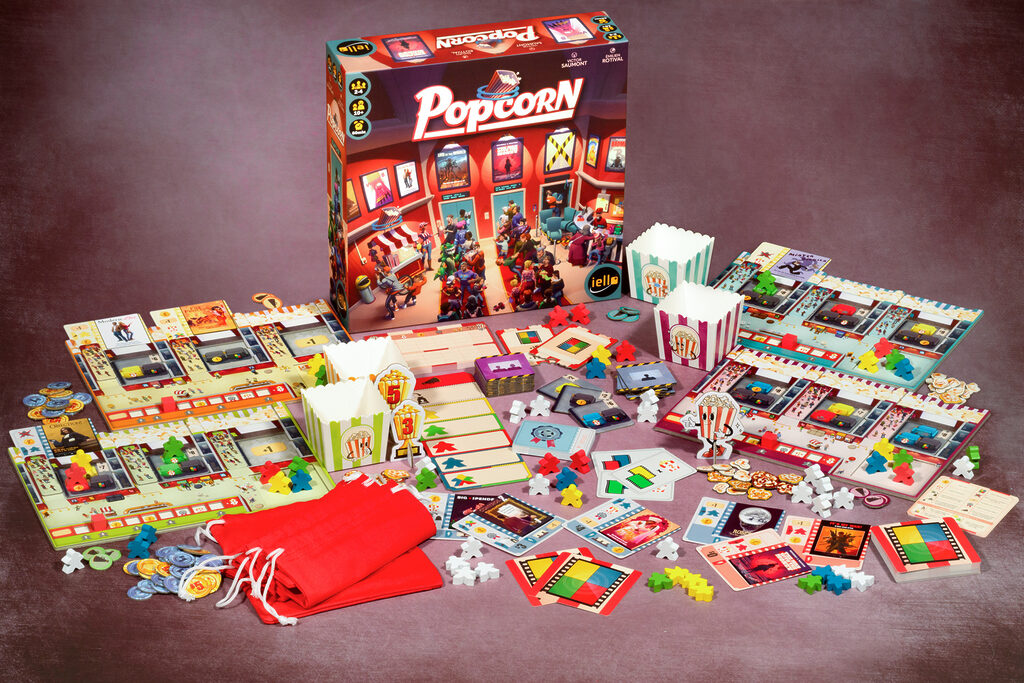
I’m a sucker for a good theme, and there are few themes that connect with me better than Movie theatres. Back in my early adulthood, a combination of sudden disposable income and lack of post secondary educational prospects, I saw almost every movie that hit the theatres that summer. Popcorn, designed by Maxime Demeyere and published by Iello, embraces the theme of running your own movie theatre, complete with spoof-filled movie posters, and I’m here for it.
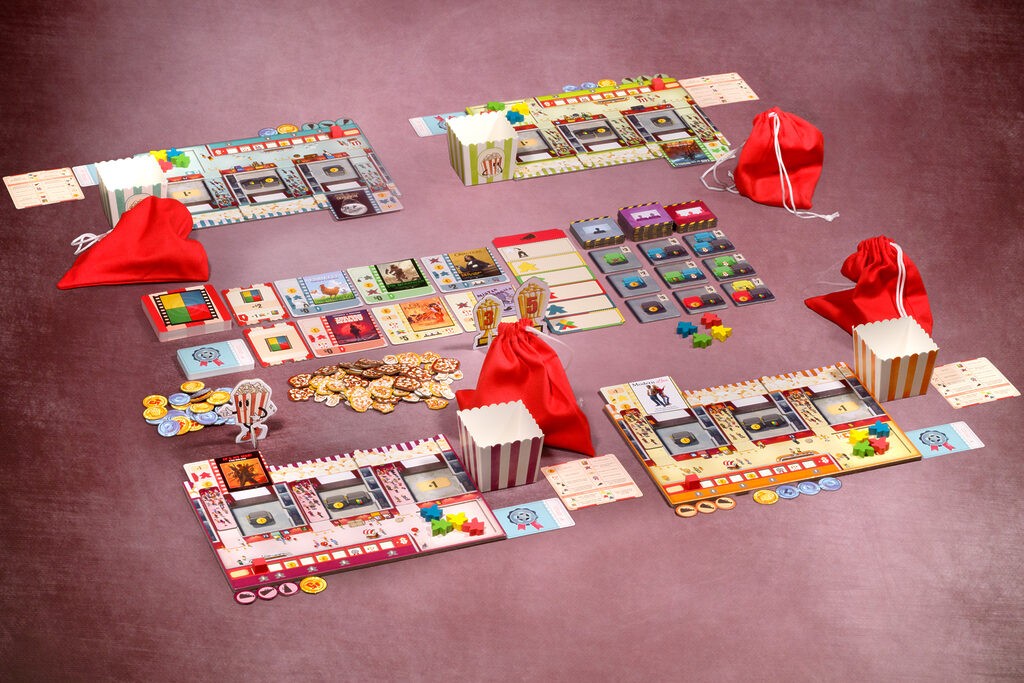
Even before I knew how it played, I wanted to play it. When it popped up on Board Game Arena, the cartoon art and cheeky parodies of blockbuster films had me grinning before I’d even looked at the rules. At its heart, Popcorn is about efficiency through bag-building. You start with a small mix of generic and coloured meeples, who make up your initial offering of loyal moviegoers. Each round, you’ll draw from your bag, fill your seats, and activate bonuses from both the seats and the movies, if you manage to get the colours to sync up. Those bonuses will see you earning coins, hooking new customers, and popping the titular popcorn, which count as victory points.
The gameplay loop is simple but satisfying. During the pre-show phase, you can buy new movies to fill your theatres, replace the seats in your three theatres, and activate promotion tokens, which allow you to fill your bag with more meeples, either from the supply, or directly from your opponent’s discard piles. During the movie phase, you assign your meeples to seats, then activate each theatre, getting the bonuses I described above. After nine rounds, the player with the most popcorn wins, with bonus awards for everyone’s secret award cards, and some bonus points for the player who spent the most money on their theatre.
One mechanic that I found interesting was that in-between your showings, your movies slowly expire. You slide a little audience token up the side of the movie, covering actions from the bottom up. This encourages you to swap out an old film to keep your theatre humming.
Also in-between the showings is your chance to buy one new film and one set of new seats for your theatre. The markets here are quite limited, 6 total films, and 9 seats. If the colours or actions you’re desperately seeking after one of your shows has it’s actions exhausted by time doesn’t show up, you’re really up the creek without a paddle.
Popcorn sits comfortably in the “light euro” category, generally rewarding good planning but never really punishing you for making a mistake or taking a slight gamble. The obvious star of the show is the bag building mechanic, which I’ve been a fan of every time I see it employed (see Automobiles and Orleans). In Popcorn, the bag building represents you curating your audience, trying to lean into one of the genres to maximize the number of actions you get during every showing. Of course, randomness plays a major role. A bad draw at the wrong time can kneecap your plans, leaving you poor going into a new round while your movies are quickly expiring. For players who prefer full control in their euros, that unpredictability may be a deal-breaker.
For a light euro game, Popcorn does have a surprising streak of mean-spiritedness. When the visitor supply runs out, players can “borrow” guests from each other’s theatres. And I say borrow, but the reality is that you’re wholesale stealing them. Likewise, if you draft last in a round, the options for new movies might be slim pickings, but at least the rotating first-player marker keeps things fair across the session.
That said, the luck factor is real. Money is tight, and one of my plays taught me that if you run out of cash, and don’t have a seat power to generate some, you are effectively out of the game. The award cards, while perhaps adding some replayability, can feel uneven. Some are straightforward and lead into natural engines, while others depend on some lucky draws or specific combination of theatres and guests. And while the shared market of films makes for fun tension, it does mean turn order can be everything. Sitting late in a round often means your best-laid plans are eaten alive by hate-drafting opponents.
Whatever mechanical complaints might exist, Popcorn nails its presentation. The artwork is an absolute standout, every movie card is a spoof of a real blockbuster, complete with witty taglines and tongue-in-cheek flavour text. Looking at pictures and videos of the physical production, The components themselves are just as charming. The first player token, a vintage popcorn bucket character that looks pulled right from the Steamboat Willy era of animation, is thematic perfection. The dual-layer theatre boards look to keep everything stable, and each player gets their own charming popcorn bucket to store their victory points.
There’s a sweetness to Popcorn that reminds me of games like Quacks of Quedlinburg or Cubitos. It’s light, colourful, and just a little bit unruly. You can teach it in five minutes, play it in an hour, and still have room for dessert afterward. But perhaps a bit like empty calories, while it was satisfying in the moment, there was little of substance that made me want to come back. Many modern euro games are great to play once, and I feel that Popcorn is one of those examples. It looks and plays great the first time you get it to the table, but there’s little there to pull me back in. The variability in gameplay comes from the movie market and award cards. The game feels the same every single time, and there’s precious little in the way of system mastery to be explored here. Just, hope the luck plays out in your favour.
Popcorn is the perfect game to play at a board game café. It has some clever ideas that are fun to explore, great humour in the cards, and the game doesn’t overstay it’s welcome. It doesn’t reinvent the bag-building mechanism, but it does manage to feel fresh right out of the box. It’s a good game to play once, especially if you have a particular fondness for the cinema.