The games being built off of the Pandemic system are getting harder and harder to spot. Since 2017’s Pandemic: Rising Tide, the word Pandemic has been scrubbed from the title of all the games that reimplement this iconic cooperative system. Fall of Rome, Star Wars: The Clone Wars, and World of Warcraft: Wrath of the Lich King at least all have a logo on the cover of the box, showcasing that the game contained within is using the Pandemic system. The most recent game utilizing this system, The Lord of the Rings: Fate of the Fellowship has omitted it from the cover all together.
I’m already off-topic. World of Warcraft: Wrath of the Lich King was designed by Justin Kemppainen, Todd Michlitsch, Alexandar Ortloff-Tang, and Michael Sanfilippo, and published by Z-Man Games in 2021. In World of Warcraft: Wrath of the Lich King, you and the other players are cooperatively journeying through the frozen continent of Northrend to face the armies of the Lich King. You each take on the mantle of one of the iconic heroes, such as Jaina Proudmoore or Thrall, and move through villages slaying ghouls and evading abominations while you take on quests before sidling up to The Lich King himself.
If you’re familiar with any Pandemic game, you’ll already feel right at home. On your turn, you take 4 actions, then draw two cards from the hero deck. Assuming you don’t draw any “The Scourge Rises”, then you’ll draw cards from the scourge deck and deploy one ghoul to each location you just drew. If you needed to add a 4th to a single location, you don’t do that, but instead move the despair token one space down on its track. Once ghouls have been summoned, the abominations each activate, which means moving one space closer to the closest hero, and dealing one damage if they manage to land on the same location as any hero.
The actions are simple. Move to an adjacent location, battle (which is just rolling two dice and dealing hits based on the result, and taking one shot of damage if anything is left standing after your attack), Quest, which I’ll get back to in a second, and Rest, which has you roll the dice and heal damage equal to the number of successes you rolled.
The quests, are established at the start of the game. There’s 3 to overcome, one in each of the 3 regions of the board. To complete a quest, you’ll need to move your character mini to the location where the quest is located, then take the quest action. You roll the two dice, and move a token along a track for every success you rolled. You can also reveal (not discard) a card from your hand to move an extra space, if the card type matches the space on the track. As a raiding bonus, every character pawn in that quest location can reveal one card, encouraging you to party up to overcome the threats.
After a quest action, generally, bad things happen. Most will deal 2 or 3 damage to whomever initiated the quest, and others will spawn ghouls on your location, or negate some of your successes. Either way, you’ll quest over and over again until the token reaches the end of the track. A reward will be given to the player who initiated the successful quest, and the quest is removed from the game. Complete 3 quests, and the final quest, the siege of Icecrown Citadel becomes available. Complete that quest, and you’ve won the game!
Most coop games have a variety of losing conditions. In World of Warcraft: Wrath of the Lich King, the only thing that really matters is the despair track. That goes down one space every time you need to add a 4th ghoul to a location, and it drops by 2 spaces anytime a player character dies (which they discard their hand of cards, then simply respawn at their starting location).
Eagle-eyed readers may have already noticed that there’s quite a bit omitted from the core Pandemic experience. Firstly, there’s no trading mechanism. The cards aren’t used to build strongholds or collecting sets to cure diseases, nor are they used to zip around the map, addressing the critical outbreaks as they flare up. Instead, cards are just held in your hand until you want to use their ability, like moving a few extra spaces, adding extra successes to an attack, or defending from hits.
Another simplification is there are only 3 regions instead of 4, but the real change is in the ghouls. There’s only one type of mob that goes all over the map. When the Scourge rises, another Abomination is added to the map, but you’re able to kill those by dealing 3 hits to it in a single action. The ghouls also don’t outbreak, should you need to put a 4th ghoul into a location, you just drop one on the despair track. No longer are you then adding one to every adjacent location.
The result is the easiest and least interesting Pandemic experience I’ve had so far. I do like that there is some variability in the character powers you’ll play with, and the different quests, but nothing about World of Warcraft: Wrath of the Lich King makes me want to come back and play it some more. While I’m not a WoW fan, I am a Pandemic fan, and I enjoyed Warcraft III quite a bit back in the day. I like the world, I like the minis of the characters and the abominations quite a bit.
The titular Lich King himself was quite underutilized. He has his own, hefty mini, but he’s relegated to just standing watch over a region for most of the game, dealing out a single extra hit when you’re questing to battling in his region. The final confrontation? You turn his castle over, put him on top, and then there’s just another track to run through. Sure, it’s slightly longer than the other quests, but it’s not particularly punishing. Also, there’s only one final quest in the game, so that track will never change. It makes me wonder why it was a card and not just printed right on the board in the first place? Perhaps an expansion hook that never came to fruition.
The dice mechanics does give the game a bit of a push your luck element. You can roll the dice and hope to smite all the baddies from a single location, and should you fail, well, you’ll probably have the cards to make you succeed anyways, or the cards to prevent anything bad from happening.
The gameplay does devolve into a repetitive loop of move and combating if ghouls are nearby or spawning too many, then squatting on the quest marker and just “quest, quest, quest, quest” until the track is finished. Sometimes you might move off the quest marker to rest, but it’s a very repetitive game. It’s kind of funny because in base Pandemic, it’s largely the same. “move, cure, move cure”, but that system has so many more interconnected layers that where you choose to move, which locations you cure are vastly more interesting that what this game has to offer.
I think the biggest problem with World of Warcraft: Wrath of the Lich King, is that every other Pandemic variant does it better. Fall of Rome does dice combat, but also has a much more interesting marching mechanic. If you have diehard WoW fans in your life, this might convince them to spend an evening away from their keyboards and around the table with you, but it lacks any excitement that might make them want to stay. I have to imagine that if you love the theme, you’ll love seeing the characters you play as, all the art on the cards, and playing with the minis. But this is a Pandemic game worth skipping.
Another year has passed, and like everyone else, I like to spend a lot of December thinking about the year that’s just passed. This is my version of a “Year in review” that you’ll see many reviewers and media folk engage in. My real problem is that I just don’t play very many games the year they’re released. It’s a byproduct of being a cave dwelling Canadian troglodyte and never going to any of the conventions, the hot new games just don’t show up on my FLGS shelves. And the rate at which I acquire games is pretty suppressed when I’m not at conventions soliciting for review copies to plaster all over social media.
Sidebar, I do get quite annoyed whenever a convention ends and my social media is flooded with media folk posting their hauls and not disclosing which of the games they got for free. It creates an illusion that is detrimental to many people’s mental health, and I wish we as an industry were better.
Getting off that soap box, I’m going to list my top 10 new to be board games that I played in real life this year. I’ll have a separate list for my favourite BGA games next week, so look forward to that!
10 – Argent: The Consortium
Designer: Trey Chambers | Publisher: Level 99 Games | Full Review
Argent: The Consortium is a worker placement game from 2015 that remains interesting and engaging. I acquired solely because of how much I’ve enjoyed Level 99 Games other games, and this design holds up. It’s not perfect by any stretch, but I’ll be damned if this isn’t the most interesting, interactive, and clever worker placement game I’ve played in a long time. It’s the kind of game that ruins other worker placement games for you. I did post a full review of Argent last month if you’re interested in reading more about it!
9 – Tragedy Looper
Designer: BakaFire | Publisher: Zman Games
Another old game I picked up from a math trade, Tragedy Looper is a deduction game from 2011. Leaning hard into the anime aesthetic, Tragedy Looper actually really reminds me of Higurashi: When They Cry, which, may or may not be a turn-off for those who have encountered that series before. In Tragedy Looper, the players are tasked with preventing a tragedy from happening, but they don’t know exactly what the tragedy is, or what roles each of the characters are playing. When a loss condition occurs, the game resets, or loops, and players only have a certain number of loops to figure out what exactly is going on, and prevent the mastermind from fulfilling his dark desires.
What kept this game on mine (and many others) shelf of shame for so long, is that it’s a one vs. many type of game. One player needs to play the mastermind, who gets access to all the information right away, and is trying to bait and trick the players into wasting their precious loops as they figure out the details of what’s going on around them. It’s a much less interesting role, as the mastermind, as you sit in your own head and play your cards, then watch the other players discuss and plot for 10 minute rounds.
But the deduction is exciting. Making unexpected moves to throw make the players think someone is a killer when they’re not, playing cards as a feint to try and get the players to waste their turns countering your cards makes for a unique experience. As far as one vs many games go, I’d MUCH rather play another game of Tragedy Looper than something like Beast
8 – Things in Rings
Designer: Peter C. Hayward | Publisher: AllPlay
Q: What does a belt, moose, flamingo, and a guitar all have in common?
Things in Rings is Venn diagram the board game. With 3 rope circles on the table, creating a triple Venn diagram, the mastermind is given 3 cards dictating the rules for each of the circles. Players are dealt a hand of cards, and need to play cards in or out of the diagram depending on the rules they don’t even know. After playing a card, the mastermind either confirms or reject the placement, moving the card to the correct location if necessary. If the player was correct, they continue placing cards, if incorrect, they draw a new one to replenish their hands. The player first to play all their cards is the winner.
Explaining it like that is a pretty boring description, but trust me when I say that Things in Rings is a brilliant little party game. The Dr. Seuss style art by Snow Conrad does a lot to help the whimsy of the game, but placing cards and watching the mastermind give you a thumbs up or down is delightful. Your mind will stretch and bend trying to figure out what sets of cards have in common with each other, until the game comes to an end and the answers are revealed, usually to uproarious laughter. Things in Rings is a delight, and I can’t wait to play it again.
Reiner Knizia has had a long and storied career, but one of his latest games, Rebirth was a delightful surprise. Generally when I see Knizia’s name on the box, my brain immediately goes to the brown and beige of Ra and Tigris and Euphrates, but Rebirth is awash in colour. Lush verdant landscapes invite the players to start plonking down their tokens, claiming parcels of land for themselves.
Rebirth is easy to learn and play, yet makes you feel like your decisions matter. Building clusters of your tokens is important, as is getting to the most valuable spaces first. Rebirth was a delightful euro surprise that I’d be happy to introduce to my mom, who loves games, but can’t internalize too many complex rules.
6 – Cockroach Poker
Designer: Jacques Zeimet | Publisher: Drei Magier Spiele | Full Review
I bought Cockroach Poker on a bit of a whim, and kind of fell in love with it. Rife with double think and bluffing, Cockroach Poker excels at building tension and creating exciting moments and opportunities for smack talk.
I get that not everyone likes pure bluffing games, but Cockroach Poker has zero stakes. Every game I’ve played has ended in gut busting laughter, and it’s over pretty quickly. It’s the perfect pub game.
5 – Trio
Designer: Kaya Miyano | Publisher: Happy Camper | Full Review
Originally published as Nana, I’ve described Trio as Go Fish mixed with Memory, but it works so well! Everyone gets a hand of cards, and then more are dealt face down on the table. On your turn you can ask any player to reveal their highest or lowest card, and after they do so, you can ask any player to do the same, or you can flip one of the face down cards. If you reveal a match, you get to do a third action. If all 3 revealed cards are a match, you take them as a trio! Take 3 trios and you win the game!
Another fast and accessible game, Trio is delightful in its simplicity. Also, the elation you feel when you manage to reveal 3 cards of the same number, reminds me a bit of Skull. All the information getting revealed is available to all players, so as the game goes on, presumably people are building mental maps of who has what. Unless you’re me and are just playing based on vibes.
While I’m not the most keen on deduction games, Bomb Busters was an explosive surprise this year. A cooperative game in which players are trying to snip all the wires except the bad ones. The trick is you don’t know which wire is which when you’re snipping!
The production on Bomb Busters is delightful, mostly the art by Dominque Ferland. It’s a charming and evokes the same feelings as Minesweeper. It’s the kind of game that once it clicks, you can play it over and over and over until either you finish all 66 missions, or the sun comes up. Whichever happens first.
3 – SETI: Search for Extraterrestrial Intelligence
Designer: Tomáš Holek | Publisher: Czech Games Edition
Man, talk about a game rocketing up the BGG top games list. I didn’t realize it until I was making this list, but it’s already reached #27, making it the highest ranked game that came out in 2024.
SETI: Search for Extraterrestrial Intelligence is a complex euro game about searching the galaxy and beyond for alien life forms. Given scant resources in this tight economy, you’re asked to stretch your actions as far as possible to build an engine to propel yourself to victory. There’s a lot going on in SETI, but I think the best thing I can really say about it is that we initially played it at our local board game café, and just as we were counting up the final score, one of our players stood up, walked over to the shelf, and grabbed a copy to buy, right there on the spot.
Since that day, she’s played it over a dozen times and is falling in love with it more and more with every play. If that isn’t a glowing recommendation, then I don’t know what is.
2 – The Gang
Designers: John Cooper, Kory Heath | Publisher: KOSMOS | Full Review
Talking about games that got a bit overplayed, The Gang went over like gang busters when it hit our table early this year. There was a four or five week stretch where this was getting pulled out before or after every game. In The Gang, players are cooperatively trying to sort out their poker hands. With limited information, players take a chip from the centre of the table indicating where they think they’ll end up in the hierarchy when all the cards are revealed. It was easy to play, and even easier to say “just one more round” again and again.
I always need to caveat that none of our players had any real experience with Poker, so this was largely an exercise in a bunch of rookies playing in the mud. But boy did we have fun doing it!
1 – Fit to Print
Designer: Peter McPherson | Publisher: Flatout Games
I’ve always said I love real time games, and Fit to Print is no different. As editors of the local newspaper, you’re all scrambling to assemble articles, photographs, and ads to earn the most points and money over a hectic weekend. First, you’ll scramble to pick up tiles and put them on your desk, then when you think you have all the tiles you need, you’ll move into the layout phase, where you place the tiles onto your board. If you overcommitted, extra articles that don’t make it onto the paper lose you points, and if you have huge swaths of empty space, you guessed it, lost points. Also, you have to have variety, so ensuring all no columns to pictures touch each other is pivotal in making a good-looking newspaper.
I find Fit to Print easier to play than Galaxy Trucker, while still retaining the same feeling of panic and stress that I relish. It doesn’t result in the uproarious laughter that Galaxy Trucker delivers, but it’s still a really fun game. I love playing it, and the Ian O’Toole art makes it a delight to look at.
Alright, that’s enough from this cave-dwelling Canadian troglodyte. What was YOUR favourite new-to-you game this year? Tell me in the comments so I can immediately convince myself I “need” it and then spend January explaining to my family why another box showed up on the doorstep.
How many puzzly abstract games do I actually need in my life? While the answer is N+1, I have to admit that I’ve been holding off on picking up Harmonies for much too long. Harmonies, designed by Johan Benvenuto and published by Libellud in 2024, garnered a lot of praise the year it was released, hitting a lot of peoples top games of the year lists, and even picking up a Spiel des Jahres recommendation and the Golden Geek award of Medium Game of the Year.
To oversimplify Harmonies, think Azul mixed with Cascadia. While that’s woefully underselling the game, it does put you into the right frame of mind. In Harmonies, you’re building a landscape on your personal player board, creating harmonious habitats for the various animals that could call your board home (see what I did there?) That’s largely where the Cascadia influence comes from.
The Azul part comes from the terrain disc market and how terrain discs are distributed. There are 5 market discs, each market gets 3 terrain discs randomly drawn from a bag. On your turn, you simply need to take all the discs from one of those markets, and place them on your board. There’s also a market of 5 animal cards that you can pull from, which will influence how you score points.
I suppose this is another Cascadia feeling part of the game. You’ll earn half your points from the terrain discs on your board, and then the other half of your points come from the animal cards you’ve drafted, depending on how well you’ve catered to their habitat needs.
Each animal card has a pattern of terrain discs that needs to be fulfilled, and a number of times that the pattern can be deployed. If at any point the pattern is present on your board, you move a cube from the card onto the pattern as dictated by the animal card. If there are no more cubes remaining on the card, then you can remove that card from your play area, freeing up a spot to take another animal card.
The cadence of Harmonies is calm, and the puzzle is satisfying. Ideally, you’ll want to pick several animal cards that synergize together well, so you can be working toward multiple cards at the same time. But inevitably, luck will decide if you’ll be able to achieve your goals or not. I can’t tell you how many times I’ve gotten a really great set of animals, all working together off the same terrain features, only for that terrain feature to just never show up.
With that in mind, I feel the need to comment on how little player interaction. In Azul, Cascadia, and others, an important part of being competitive is hate drafting the resources your opponents desperately needs. In Harmonies, the opportunity cost is dramatically high. Taking a card that’s at odds with the terrain you’re building only really hurts you. This isn’t the kind of game that you can win by dragging others down.
Thankfully, Harmonies is short. Once a player fills their player board up until they have 2 or less empty spaces remaining, the round is finished, and the game comes to an end. Not all players will achieve this on the same turn, as certain terrain types do stack. If you get a little screwed by the random chance, it’s real easy to drop everything into the bag and try again.
The production on Harmonies is beautiful. From the art on the cover and tarot sized cards, to the thick, bright wooden discs, Harmonies is a great looking game. And the cardboard insert the game comes with is very functional, which is a welcome treat.
Harmonies deserves all the praise it’s gotten so far. It’s a gorgeous spatial puzzle that’s both soothing and surprisingly demanding. It plays smoothly across player counts, teaches in minutes, and rewards careful planning without becoming punishing, unlike something like Calico. The tactile joy of placing its wooden tokens never really wears off, and the blending of terrain-scoring and pattern-matching keeps my brain pleasantly engaged every time I sit down to enjoy this puzzle.
In addition to my weekly Wednesday night group, I almost always have a small mass of async BGA games ticking away in the background. Normally, I prefer to learn games in real life. Something about touching cardboard and making eye contact with the person whose plans I’m about to ruin. Also, not having a computer to run the rules for me makes me internalize the rules much better. But this year I’ve been much more willing to join various random games pitched by the more active members of the BGA groups I’m a member of. Specifically, The Nerd Shelves and Board Game Hot Takes, where there’s a bustling little community of BGA degenerates constantly offering up new games for public participation.
And they succeeded, because I ended up playing enough new titles to make a whole top 5 list of standouts. Let’s get into it.
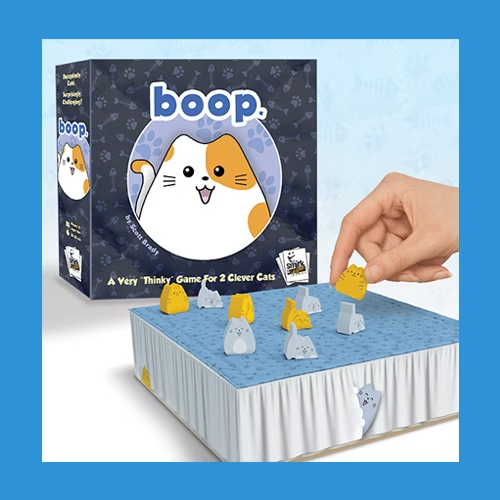
5 – boop.
Designer: Scott Brady | Publisher: Smirk & Dagger Games
Don’t let the aggressively cute theme fool you. boop. is a razor-sharp abstract game that sinks its claws in fast. Every time you place a kitten, it “boops” neighbouring kittens one space away, creating a constant spatial shuffle that feels equal parts tactical puzzle and chaotic cat herding. Get three kittens in a row and they graduate into big ol’ cats. Get three cats in a row and you win. Simple, right?
Wrong.
What I loved most was the game grows naturally. It’s not like chess where you engage in a war of attrition, slowly whittling down the opposing army’s strength while trying to preserve your own units. The game starts as a blank canvas, and only your supiror kitty placement will prove you the victor. Every move feels meaningful, and the swingy endgame is deliciously tense as the bed becomes littered with cats and both players are participaing in a dangerous dance to see who manages to trap the other player first. The more I played it, the more hidden depth I saw in boop.
4 – The Guild of Merchant Explorers
Designers: Matthew Dunstan & Brett J. Gilbert | Publisher: AEG
The Guild of Merchant Explorers is basically a solo map exploration game. Flip a card, place cubes on matching terrain, expand your network, score stuff, then wipe your board and do it again. Each round you also gain a unique power card, which gives the next round a bit of fresh fun.
The Guild of Merchant Explorers is low-interaction and pretty heads-down, which kind of makes it a perfect async BGA game. Everyone is lost in their own little map and the person with the most points wins, but the puzzle is engaging, which makes this worth playing. If you’re like me, and you’ve grown a bit tired of Kingdom Builder (or Bigfoot just keeps beating you), The Guild of Merchant Explorers scratches a lot of the same itch. I’ve read that the physical board game can be a bit fiddly with all the tracking and resetting, but that’s not an issue on BGA!
3 – Captain Flip
Designers: Remo Conzadori & Paolo Mori | Publisher: PlayPunk
Captain Flip is the kind of breezy filler that immediately turns into “okay, but let’s play again.” Draw a tile from the bag, decide whether to keep it as is, or flip it for the random other side, and slot it into your crew tableau for points. But once flipped, no take-backsies.
Every turn is awash in push-your-luck temptation. Do you take the known mediocre pirate or flip and pray for glory? Then you place them on your board and try to make it work. Captain Flip is quick, the art is funny, and somehow the decisions stay interesting across repeated plays. I keep thinking I’m done with it, but my heart just keeps asking for one more game. Just one more and I’ll be satisfied, I promise!
2 – Tag Team
Designers: Gricha German & Corentin Lebrat | Publisher: Scorpion Masqué
This one blind sided me. Tag Team is an auto-battler crossed with a deck-builder. You pick two fighters, each with their own mini-deck, mash them together, and unleash them in a battle where you have no control. Your cards flip one by one while you pray your attacks trigger before your opponent’s defences do. You never shuffle your deck, you just add one card each round, then during the combat phase, there are no decisions to make. You flip over the cards and do what they say, it’s all preprogrammed.
The magic here is the learning loop: round one, you have no idea what order your opponent has put into their deck. Round two, you start planning counters, their second card was an attack, so you should slot a defence card to counter it. In round three, you’re fully working towards synergies and tweaking your own deck, hoping to outthink your opponent. It’s fast, clever, and most importantly exciting. When you and your opponent are at critical health, you watch the cards flip and just hope you placed your defence card in the right spot to hit them with a critical counter-attack.
I will say that one of my opponents said that Tag Team was about as exciting as playing War, and I can see where she’s coming from. I disagree, I think Tag Team is as brilliant as the 2023 Kennerspiel des Jahres winner Challengers, but I get where she’s coming from.
1 – Coffee Rush
Designer: Euijin Han | Publisher: Korea Boardgames
The #1 spot goes to the game that surprised me the most: Coffee Rush. It’s essentially an order-fulfillment puzzle where players scramble around an ingredient grid trying to gather the ingredients for drinks before the queue plunges into chaos. The game starts as a calm “latte, in 3 turns please.” but it quickly becomes a frantic race as the orders pile up, and the pressure starts to ring in your ears.
I’ll have a full review of Coffee Rush soon, because I’ve been enjoying it so much, but what makes it shine is probably my own bias. I used to work in kitchens, and seeing the orders pile up and tick down as you frantically knock them down makes my soul sing. You’re constantly managing tiny crises, every planned route is one step too long, and every upgrade you unlock feels like a restocked station. For a game that was so easy to grasp, it delivered a satisfying amount of brain burn. If I had this on my table, I’d almost certainly impose a timer to really make it feel stressful, just like working in a café.
Those have been my 5 favourite new to me games on BGA this year. Are you looking for a new player on BGA? Hit me up with a game invite anytime. I can’t promise brilliance, but I can guarantee enthusiasm, and I take my turns at least 3 times a day.
My 4-year-old has recently been absolutely smitten with the movie WALL-E lately. A ruined world left barren and destitute, filled to the brim with trash and catastrophic dust storms suddenly whipping up to create a moment of tension. The first sign of life appears as a green shoot poking up from the dust, and that little speck of life is what brings the Axiom and all its inhabitants home from it’s 700 year journey.
Revive, by designers Helge Meissner, Kristian Amundsen Østby, Eilif Svensson, and Anna Wermlund, and published by Artipia Games in 2022 seeks to replicate a similar feeling with the cover of their game. An icy, frozen wasteland marked by a pair of yellow flowers poking out of the desolate landscape, representing the earth healing itself. The game itself takes place on a blue board laden with icy blue tiles, with only the very centre of the map being inhabitable.
Each turn, a player has two actions. They can play one of their cards to the top or bottom of their player board, and take the corresponding resources or action on that card, or they can spend their resources to explore, where they flip over icy tiles and recruit new survivors, they can populate, where they leave a population marker that improves their clan ability, or they can build, which improves the technologies on their player board.
I’m trying to keep the actions of the game tied to the theme, but the honest truth is that while Revive has an incredibly distinct art style and presentation, the theme falls apart when trying to tie them to the mechanisms. The reality is that when you start playing Revive, you’ll quickly stop thinking about the theme of rebuilding society after 5,000 years of devastation. Instead, your mind will reduce everything to it’s base elements and abstract rules that make up the gameplay.
And I’m okay with that, because the gameplay is incredibly satisfying. The player board for Revive is incredibly striking. First, it’s huge. Secondly, it’s such an irregular shape with notches carved out of the top, bottom, and right side for you to place your cards, and a small notch on the left for you to stick your clan board. Lastly, the centre is dual layered and dominated by 3 tracks spiralling out with over a dozen things to uncover.
Building the buildings will send the little cylinders on your player board along their designated tracks, pulling discs off your board and earning you machines, which are bonus actions that cost energy to use. The machines can offer you a plethora of goodies, from just straight resources, to beneficial conversions, to discounts on certain actions, and even allowing you to play the bottom half of a card on a top slot.
Speaking of the slots, at the beginning of the game, playing one of your cards for resources will net you only the resources on the cards. But plugging in slot modules will net you extra resources, if the card you play to that slot matches the colours of the slot modules. Some of the cards even allow you to layer further cards on top of the same slot, allowing you to trigger those slot modules again and again. But you can’t JUST play cards, each of the 3 resources has a hard limit of 6, encouraging you to consider timing and tempo as you earn and spend your resources.
The board itself starts the game shrouded in mystery. From a central point, all players fan out, flipping over tiles to earn points, get new cards, and reveal terrain types, which will push the cylinders on your player board when you build next to them. But just because you revealed a terrain tile, doesn’t mean that it’s your terrain. If you decide to leave it for a turn, another player can swoop in and plonk their building down on your newly discovered home. And you’ll really need to ensure other players don’t do that, because building on the juiciest spaces is lucrative and propels your engine further and further, and each hex can only accommodate a single building.
Every time you build a building, you’re establishing for yourself another post from which you can venture outwards. When you explore, build, or populate, you’ll need to pay food to cover the distance. The more you put out onto the board, the easier it is to get around. Each of the corners of the maps is also home to a large scoring tile, which you only get access to if you populate onto it. Speaking of populating, not only does putting your meeples onto the board give you a jumping off point for future actions, it also unlocks more of your tribe’s ability. The base game comes with 6 factions, each with unique quirks and powers. Each of those factions are also double-sided, giving you plenty of asymmetry to explore.
Revive doesn’t have rounds per-se. Instead of a regular turn, you can choose to hibernate. Doing this pulls all the cards from your hibernation state, all the cards you’ve slotted in are then moved to the hibernation state, freeing up the slots to be used again. You pull all the energy off your machines, enabling them to be activated again, and then you get a little bonus depending on how many times you’ve hibernated. The hibernation track also has a built-in end game accelerator, where if you hibernate for the 4th time, you discard one of the artifacts from the game entirely. But in all my games, I think I’ve only seen that happen once.
I’ve talked a lot about what you can do, but I haven’t talked about why you do. At several junctions in Revive, you’ll earn an artifact. Populating the top tier of your tech tracks, getting your 6th disc onto your player board, getting your 10th and 5th cylinder movement on each of the tracks, and earning 15 points all allow you to take an artifact. These strange, alien skull things come in 3 flavours, silver, orange, and purple, and each flavour of artifact one corresponds to an end game victory condition that’s different for every player, as dictated by a hidden card you’ll receive at the start of the game. Perhaps my silver artifacts give me a point for every slot module I’ve earned, while your opponent’s silver artifact nets them a point for every card they’ve obtained throughout the game. The important thing to remember here is that the artifacts are limited, and their score is multiplicative.
Combining the corner victory point tiles with the victory points you’ll earn from the artifacts you collect are how you will claim victory in Revive. Being able to combine or double dip on a scoring criteria, such as a corner tile giving you one point per slot module, and one of your artifact conditions giving you one point for every 2 slot modules per artifact you collect can inform your choices during the game, but it’s important to remain flexible. There are only a small handful of each artifact available, and if someone else is chasing the same artifact you’re chasing, then by the time the game is half over, the artifacts that would benefit you the most, are simply exhausted.
The end of Revive comes up dramatically quickly. The end game trigger is when all the artifacts are exhausted, which, taking an artifact is generally a reward for maxing out one aspect of the game. At the halfway point, one or two players may have claimed a single artifact. But in the last round or two, it’s not uncommon for a chain of actions to result in one player picking up multiple artifacts. You might feel safe when there are 4 artifacts remaining on the board, but the game can come to an end surprisingly quickly.
I think my only real complaint or criticism about Revive is the included ‘campaign’. When you open a new copy of Revive, you’ll be suggested to play this 5 game campaign, which introduces concepts and rules piecemeal over the course of the campaign. It’s unnecessary, slow, and a perfect way to ensure players don’t experience a full game of Revive. In a world where I only have 1 game night per week, and 4 friends all with their own board game collections and new games trickling in all the time, having a watered down first experience as a stepping stone modular tutorial towards a full game is a recipe for a great game getting lost in the shuffle. Perhaps the bigger sin is putting some of the advanced rules that come in during the campaign on cards that I keep forgetting when I’m trying to reference an edge case in the rulebook.
Revive has become one of my favourite medium-heavy euro games of the past few years because it delivers that rare mix of momentum, creativity, and tension that keeps me thinking about it long after the game is over. Even if the theme melts away the moment you start optimizing your gameplay, it does manage to evoke the feeling of moving from scarcity into abundance. Turn by turn, you chip away at this frozen puzzle until suddenly everything starts to hum, and your engine erupts in a cascade of actions you spent an hour patiently setting up. Those moments where you chain machines, chests, cards, and faction abilities into a single, absurdly powerful turn are the reason I keep coming back. It’s clever, it’s crunchy, and it’s endlessly satisfying.