This review is based off my plays on Board Game Arena. If I play it in person in the future and my opinions change, I’ll be sure to amend this review.
I’m a sucker for a good theme, and there are few themes that connect with me better than Movie theatres. Back in my early adulthood, a combination of sudden disposable income and lack of post secondary educational prospects, I saw almost every movie that hit the theatres that summer. Popcorn, designed by Maxime Demeyere and published by Iello, embraces the theme of running your own movie theatre, complete with spoof-filled movie posters, and I’m here for it.
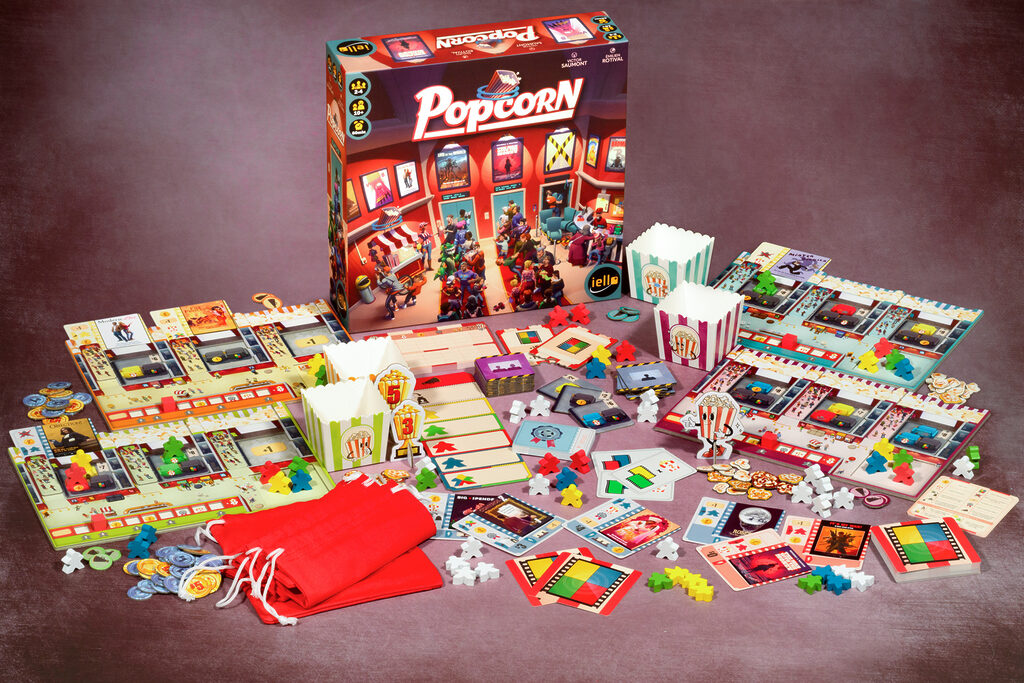
Even before I knew how it played, I wanted to play it. When it popped up on Board Game Arena, the cartoon art and cheeky parodies of blockbuster films had me grinning before I’d even looked at the rules. At its heart, Popcorn is about efficiency through bag-building. You start with a small mix of generic and coloured meeples, who make up your initial offering of loyal moviegoers. Each round, you’ll draw from your bag, fill your seats, and activate bonuses from both the seats and the movies, if you manage to get the colours to sync up. Those bonuses will see you earning coins, hooking new customers, and popping the titular popcorn, which count as victory points.
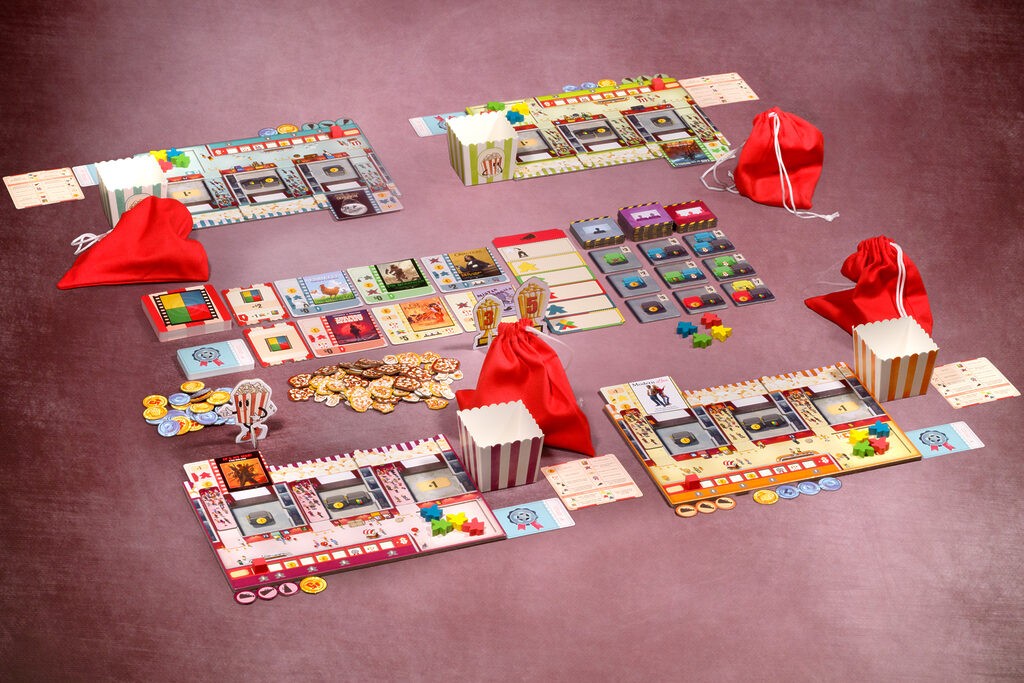
The gameplay loop is simple but satisfying. During the pre-show phase, you can buy new movies to fill your theatres, replace the seats in your three theatres, and activate promotion tokens, which allow you to fill your bag with more meeples, either from the supply, or directly from your opponent’s discard piles. During the movie phase, you assign your meeples to seats, then activate each theatre, getting the bonuses I described above. After nine rounds, the player with the most popcorn wins, with bonus awards for everyone’s secret award cards, and some bonus points for the player who spent the most money on their theatre.
One mechanic that I found interesting was that in-between your showings, your movies slowly expire. You slide a little audience token up the side of the movie, covering actions from the bottom up. This encourages you to swap out an old film to keep your theatre humming.
Also in-between the showings is your chance to buy one new film and one set of new seats for your theatre. The markets here are quite limited, 6 total films, and 9 seats. If the colours or actions you’re desperately seeking after one of your shows has it’s actions exhausted by time doesn’t show up, you’re really up the creek without a paddle.
Popcorn sits comfortably in the “light euro” category, generally rewarding good planning but never really punishing you for making a mistake or taking a slight gamble. The obvious star of the show is the bag building mechanic, which I’ve been a fan of every time I see it employed (see Automobiles and Orleans). In Popcorn, the bag building represents you curating your audience, trying to lean into one of the genres to maximize the number of actions you get during every showing. Of course, randomness plays a major role. A bad draw at the wrong time can kneecap your plans, leaving you poor going into a new round while your movies are quickly expiring. For players who prefer full control in their euros, that unpredictability may be a deal-breaker.
For a light euro game, Popcorn does have a surprising streak of mean-spiritedness. When the visitor supply runs out, players can “borrow” guests from each other’s theatres. And I say borrow, but the reality is that you’re wholesale stealing them. Likewise, if you draft last in a round, the options for new movies might be slim pickings, but at least the rotating first-player marker keeps things fair across the session.
That said, the luck factor is real. Money is tight, and one of my plays taught me that if you run out of cash, and don’t have a seat power to generate some, you are effectively out of the game. The award cards, while perhaps adding some replayability, can feel uneven. Some are straightforward and lead into natural engines, while others depend on some lucky draws or specific combination of theatres and guests. And while the shared market of films makes for fun tension, it does mean turn order can be everything. Sitting late in a round often means your best-laid plans are eaten alive by hate-drafting opponents.
Whatever mechanical complaints might exist, Popcorn nails its presentation. The artwork is an absolute standout, every movie card is a spoof of a real blockbuster, complete with witty taglines and tongue-in-cheek flavour text. Looking at pictures and videos of the physical production, The components themselves are just as charming. The first player token, a vintage popcorn bucket character that looks pulled right from the Steamboat Willy era of animation, is thematic perfection. The dual-layer theatre boards look to keep everything stable, and each player gets their own charming popcorn bucket to store their victory points.
There’s a sweetness to Popcorn that reminds me of games like Quacks of Quedlinburg or Cubitos. It’s light, colourful, and just a little bit unruly. You can teach it in five minutes, play it in an hour, and still have room for dessert afterward. But perhaps a bit like empty calories, while it was satisfying in the moment, there was little of substance that made me want to come back. Many modern euro games are great to play once, and I feel that Popcorn is one of those examples. It looks and plays great the first time you get it to the table, but there’s little there to pull me back in. The variability in gameplay comes from the movie market and award cards. The game feels the same every single time, and there’s precious little in the way of system mastery to be explored here. Just, hope the luck plays out in your favour.
Popcorn is the perfect game to play at a board game café. It has some clever ideas that are fun to explore, great humour in the cards, and the game doesn’t overstay it’s welcome. It doesn’t reinvent the bag-building mechanism, but it does manage to feel fresh right out of the box. It’s a good game to play once, especially if you have a particular fondness for the cinema.
Zenith makes a strong first impression before you even touch a card. It’s bright and cheerful in a way sci-fi games rarely are, usually they’re leaning into the darkness of space to inform their aesthetic, see Beyond the Sun or Race for the Galaxy for examples. Zenith though, reminds me of Lilo and Stitch. Colourful planets, charming little alien creatures, and white clinical backgrounds give this sci-fi affair a more optimistic feel.
A Tug-of-war game for 2 or 4 players, Zenith by designers Grégory Grard and Mathieu Roussel has players vying for control over 5 planets. On your turn you’ll play a card to do one of 3 things. Either discard it to move up a tech track matching the suit of the card you discarded, discard it to take a diplomacy action, giving you the leadership seal, which increases your hand limit and provides you with a small amount of resources, or play the card to the tracks, which will always move a disc toward you, and then often will have a secondary effect to resolve. The game ends when someone gets 5 planet discs to their side of the board, or 4 differently coloured discs, or 3 discs of the same colour.
The first thing I noticed about Zenith was the abundance of iconography. There are a lot of symbols, and while the reference card covers the basics, it doesn’t quite prepare you for every possible combination the cards throw at you. It’s never impossible to decipher, but I did have to use the hover-over text on Board Game Arena more often than not to be sure of what a card would exactly do before playing it. I would have really appreciated it if the rulebook had a glossary of cards with the plain language rules. That would have gone a long way in helping me through my first few turns.
While the box says 2 or 4 players, Zenith is clearly a two-player game at heart. Yes, it technically supports four, but the four-player mode feels like the designers stretching the system past where it wants to go. The box advertises a “tug-of-war strategy game,” and that’s exactly what it delivers. You and your opponent will trade off sliding discs back and forth, getting certain discs closer and closer to your zone until someone plays an unexpected card and manages to push the disc off the ledge.
The tug-of-war works here because turns are so clean and quick. You’re usually doing one of three things: play a card and pay for it to move some discs, discard a card to get some resources, or move up a track paying a different currency to gain bonuses. It’s a simple turn structure that manages to generate some interesting decisions. There’s a wonderful push-and-pull between choosing to expanding your hand size (huge in this game), building discount engines, and progressing the discs you actually want to claim for yourself, or preventing your opponent from claiming a disc too easily.
And because it’s a two-player duel, the meanness feels just right. You can steal cards which give discounts to cards of the same colour, exile your own tableau to reposition, and even yank planets away at the last second. This is where tug-of-war games usually lose me. Hurting your opponent always directly advances your own cause, and nothing ever feels unrecoverable. It feels more like a war of attrition and undoing what your opponent did on their turn instead of both players working towards an end game condition.
There is some significant luck in the card draw, and it really does matter. Sometimes you really need one specific type of card, an animal to finish off that tech track, or any blue card to just get that disc over the final line, and the deck just says “nope.” When your hand size is only four or five, that can sting. But managing your hand is a big part of the game. Especially when your opponent steals the leadership emblem, and you don’t get to draw new cards until you play some that were sitting in your hand. Taking that leadership token back will expand your hand size again, and you’ll get to draw two cards, but if you don’t have a card ability that gives you the leadership emblem, spending a whole turn to take it back really feels suboptimal.
The tech track can offer some useful abilities, and when you move up a tech track, you get the benefits of everything below it again, but there’s no persistent benefit for moving up the tracks. It’s the kind of thing where you need to be in the right position, then utilize the tech track for a big move that pushes one of the discs over the threshold. It’s fine, but I wish it did reward players in a more persistent fashion. Like if you hit the top of the robots track, now all robots cost 2 resources less to play.
For all its colour, charm, and clever little systems, Zenith ultimately sits outside the kind of experience I’m looking for. It has more going on than a Lost Cities-weight game, yet somehow feels less like it’s building toward anything. Where games like Lost Cities or Air, Land & Sea create this wonderful sense of escalation, slowly tightening the screws as each card nudges the tension higher, Zenith often feels like a stalemate of small reversals, waiting for the right tool to finally appear in your hand.
And that’s really the heart of it for me: tug-of-war games just don’t give me the payoff I want. Trading blows back and forth, undoing each other’s progress, watching discs shuffle the same few spaces back and forth, it’s not the kind of gameplay arc that excites me. I can admire the production, the vibrant personality in the art, and even the flashes of tactical cleverness, but I never quite feel that satisfying crescendo I get from the two-player games I love. That said, if tug-of-war tension is your favourite flavour, if you enjoy tight, interactive duels where every push has an immediate pull, Zenith might land far better for you. It’s well-designed, aesthetically delightful, and offers plenty of room for smart plays.
Remember Minesweeper? Ever since I was a little kid, I was the type of person to press every button, look in every file, check every setting. When our school go it’s first Windows 95 computer, my inquisitive nature was rewarded with finding Minesweeper. Now, I’m curious, but dumb, so I just clicked around a bunch and eventually, always, blew up. It wasn’t until I was an early teenager when someone explained to me how the game worked. It wasn’t just a random grid of mines and numbers, it was a puzzle to be solved. Today’s game, Bomb Busters, designed by Hisashi Hayashi and published by Pegasus Spiele in 2024 evokes a lot of the same feelings as classic Minesweeper.
In Bomb Busters, players are a team of bomb disposal experts, trying to collaboratively cut all the wires to disarm the bomb, while avoiding the trigger wire that will spell disaster for everyone around the table should it be cut. At the start of every game, 48 tiles, 4 each of numbers 1 – 12 are face down and shuffled up. Then, a few yellow and red tiles are added to the mix, and the tiles are distributed as evenly as possible amongst all the players and set in ascending order in each player’s tile tray.
On your turn, you choose a tile of your own, then point to a single tile in someone else’s tile try, and declare what number that tile is, matching the tile of your own that you chose. If correct, you both lay the tile down in front of your trays. If wrong, the other player takes an information token and places it in front of the tile you chose, revealing it’s number for someone else to cut on a later turn, and reducing the game timer. If the game timer runs out, or if anyone ever happens to point to the red wire, boom. The game is lost. To win the game, all players need to fully empty their tile trays.
To assist you in your bomb diffusing efforts, each player has a power, and as you cut certain numbers, you unlock tools that you can use to tilt the odds of the game into your favour. These tools can let you swap a tile with someone else, or label two tiles in your tray as “matching” or “not matching”. Choosing who and when to use these tools can be the difference between victory and defeat, or at the very least, if someone is in a situation where they have a 50% chance to cut the red wire, then they can really save the crew from disaster.
Bomb Busters starts with an 8 game introduction. Very slowly introducing mechanics and concepts to players, and then making those concepts a touch harder over the course of several plays. Our group, skipped to the 3rd mission, then the 6th, then the final mission. I’m generally a fan of the learning games, but in the case of Bomb Busters, I think the first few missions were entirely too easy. But if you have players in your group that struggle to learn rules by someone talking at them, it’s a useful way to scaffold their learning. The last training mission is the full game experience, so if you’re the kind of person who does very well with reading a rulebook and understanding from that, you may want to consider skipping right up to that point.
When you first start playing Bomb Busters, each player will have a single information token in front of them. You’ll scratch your head, trying to figure out what your comrades are trying to tell you, and more than likely, you’ll make a blind guess or two, potentially ending the game early (hence the Minesweeper reference in the first paragraph). But after a few plays, things start to click. You start inferring more information from a single guess. Why someone might choose a specific number, figuring out what solutions they’re leading you to, it’s kind of magical in that way.
To assist those of us with stunted memories, there’s a handy board that tracks the numbers in play, and where the yellow and red numbers MIGHT be. As you progress in missions, during the set-up you’ll pull several potential yellow and red tiles, mark them on the board, but only actually put a few of them into the mix, setting the others aside, unseen. The bit of uncertainty when picking wires to cut is delicious, and when you successfully deduce your way around them, the whole table feels like they can read each other’s mind.
Bomb Busters is a friendly family deduction game, one that has you delighting in your shared victories. And the box packs in a ton of content. Beyond the 8 training missions, there are a further 66 missions to flex the system and bend your brain. The first mission after basic training includes a small deck of cards, indicating there is now a series of numbers that must be cut in a specific order.
The presence of all the extra missions reminds me of The Crew, where when you play with the same group of players week after week, the missions give a nice variety to the experience. New challenges to overcome, new twists to disrupt the groove you’ve all figured out for yourselves. I haven’t delved further into the missions yet, but I’m excited to see what tricks they’ve cooked up for those seeking bomb disposal mastery.
The base game, that is to say, the game you play at the end of the last training mission, feels full and complete on its own. A deduction game where you feel accomplished following the trail of crumbs your friends leave for you, instead of taking wild guesses in the dark. The setup is mildly tedious, needing to shuffle and distribute 70 little tiles amongst everyone, but that’s a mild criticism.
Minor setup fuss aside, Bomb Busters delivers a tight, engaging cooperative deduction experience that feels fresh. It’s the kind of game where your group slowly levels up together, learning how to read each other’s choices until the table clicks into a shared wavelength. With dozens of missions and clever twists waiting past the tutorial, there’s far more depth here than the cutesy presentation may suggests. For fans of logical puzzles and tense, thinky co-op moments, this one’s a blast. Hopefully not literally.
The games being built off of the Pandemic system are getting harder and harder to spot. Since 2017’s Pandemic: Rising Tide, the word Pandemic has been scrubbed from the title of all the games that reimplement this iconic cooperative system. Fall of Rome, Star Wars: The Clone Wars, and World of Warcraft: Wrath of the Lich King at least all have a logo on the cover of the box, showcasing that the game contained within is using the Pandemic system. The most recent game utilizing this system, The Lord of the Rings: Fate of the Fellowship has omitted it from the cover all together.
I’m already off-topic. World of Warcraft: Wrath of the Lich King was designed by Justin Kemppainen, Todd Michlitsch, Alexandar Ortloff-Tang, and Michael Sanfilippo, and published by Z-Man Games in 2021. In World of Warcraft: Wrath of the Lich King, you and the other players are cooperatively journeying through the frozen continent of Northrend to face the armies of the Lich King. You each take on the mantle of one of the iconic heroes, such as Jaina Proudmoore or Thrall, and move through villages slaying ghouls and evading abominations while you take on quests before sidling up to The Lich King himself.
If you’re familiar with any Pandemic game, you’ll already feel right at home. On your turn, you take 4 actions, then draw two cards from the hero deck. Assuming you don’t draw any “The Scourge Rises”, then you’ll draw cards from the scourge deck and deploy one ghoul to each location you just drew. If you needed to add a 4th to a single location, you don’t do that, but instead move the despair token one space down on its track. Once ghouls have been summoned, the abominations each activate, which means moving one space closer to the closest hero, and dealing one damage if they manage to land on the same location as any hero.
The actions are simple. Move to an adjacent location, battle (which is just rolling two dice and dealing hits based on the result, and taking one shot of damage if anything is left standing after your attack), Quest, which I’ll get back to in a second, and Rest, which has you roll the dice and heal damage equal to the number of successes you rolled.
The quests, are established at the start of the game. There’s 3 to overcome, one in each of the 3 regions of the board. To complete a quest, you’ll need to move your character mini to the location where the quest is located, then take the quest action. You roll the two dice, and move a token along a track for every success you rolled. You can also reveal (not discard) a card from your hand to move an extra space, if the card type matches the space on the track. As a raiding bonus, every character pawn in that quest location can reveal one card, encouraging you to party up to overcome the threats.
After a quest action, generally, bad things happen. Most will deal 2 or 3 damage to whomever initiated the quest, and others will spawn ghouls on your location, or negate some of your successes. Either way, you’ll quest over and over again until the token reaches the end of the track. A reward will be given to the player who initiated the successful quest, and the quest is removed from the game. Complete 3 quests, and the final quest, the siege of Icecrown Citadel becomes available. Complete that quest, and you’ve won the game!
Most coop games have a variety of losing conditions. In World of Warcraft: Wrath of the Lich King, the only thing that really matters is the despair track. That goes down one space every time you need to add a 4th ghoul to a location, and it drops by 2 spaces anytime a player character dies (which they discard their hand of cards, then simply respawn at their starting location).
Eagle-eyed readers may have already noticed that there’s quite a bit omitted from the core Pandemic experience. Firstly, there’s no trading mechanism. The cards aren’t used to build strongholds or collecting sets to cure diseases, nor are they used to zip around the map, addressing the critical outbreaks as they flare up. Instead, cards are just held in your hand until you want to use their ability, like moving a few extra spaces, adding extra successes to an attack, or defending from hits.
Another simplification is there are only 3 regions instead of 4, but the real change is in the ghouls. There’s only one type of mob that goes all over the map. When the Scourge rises, another Abomination is added to the map, but you’re able to kill those by dealing 3 hits to it in a single action. The ghouls also don’t outbreak, should you need to put a 4th ghoul into a location, you just drop one on the despair track. No longer are you then adding one to every adjacent location.
The result is the easiest and least interesting Pandemic experience I’ve had so far. I do like that there is some variability in the character powers you’ll play with, and the different quests, but nothing about World of Warcraft: Wrath of the Lich King makes me want to come back and play it some more. While I’m not a WoW fan, I am a Pandemic fan, and I enjoyed Warcraft III quite a bit back in the day. I like the world, I like the minis of the characters and the abominations quite a bit.
The titular Lich King himself was quite underutilized. He has his own, hefty mini, but he’s relegated to just standing watch over a region for most of the game, dealing out a single extra hit when you’re questing to battling in his region. The final confrontation? You turn his castle over, put him on top, and then there’s just another track to run through. Sure, it’s slightly longer than the other quests, but it’s not particularly punishing. Also, there’s only one final quest in the game, so that track will never change. It makes me wonder why it was a card and not just printed right on the board in the first place? Perhaps an expansion hook that never came to fruition.
The dice mechanics does give the game a bit of a push your luck element. You can roll the dice and hope to smite all the baddies from a single location, and should you fail, well, you’ll probably have the cards to make you succeed anyways, or the cards to prevent anything bad from happening.
The gameplay does devolve into a repetitive loop of move and combating if ghouls are nearby or spawning too many, then squatting on the quest marker and just “quest, quest, quest, quest” until the track is finished. Sometimes you might move off the quest marker to rest, but it’s a very repetitive game. It’s kind of funny because in base Pandemic, it’s largely the same. “move, cure, move cure”, but that system has so many more interconnected layers that where you choose to move, which locations you cure are vastly more interesting that what this game has to offer.
I think the biggest problem with World of Warcraft: Wrath of the Lich King, is that every other Pandemic variant does it better. Fall of Rome does dice combat, but also has a much more interesting marching mechanic. If you have diehard WoW fans in your life, this might convince them to spend an evening away from their keyboards and around the table with you, but it lacks any excitement that might make them want to stay. I have to imagine that if you love the theme, you’ll love seeing the characters you play as, all the art on the cards, and playing with the minis. But this is a Pandemic game worth skipping.
How many puzzly abstract games do I actually need in my life? While the answer is N+1, I have to admit that I’ve been holding off on picking up Harmonies for much too long. Harmonies, designed by Johan Benvenuto and published by Libellud in 2024, garnered a lot of praise the year it was released, hitting a lot of peoples top games of the year lists, and even picking up a Spiel des Jahres recommendation and the Golden Geek award of Medium Game of the Year.
To oversimplify Harmonies, think Azul mixed with Cascadia. While that’s woefully underselling the game, it does put you into the right frame of mind. In Harmonies, you’re building a landscape on your personal player board, creating harmonious habitats for the various animals that could call your board home (see what I did there?) That’s largely where the Cascadia influence comes from.
The Azul part comes from the terrain disc market and how terrain discs are distributed. There are 5 market discs, each market gets 3 terrain discs randomly drawn from a bag. On your turn, you simply need to take all the discs from one of those markets, and place them on your board. There’s also a market of 5 animal cards that you can pull from, which will influence how you score points.
I suppose this is another Cascadia feeling part of the game. You’ll earn half your points from the terrain discs on your board, and then the other half of your points come from the animal cards you’ve drafted, depending on how well you’ve catered to their habitat needs.
Each animal card has a pattern of terrain discs that needs to be fulfilled, and a number of times that the pattern can be deployed. If at any point the pattern is present on your board, you move a cube from the card onto the pattern as dictated by the animal card. If there are no more cubes remaining on the card, then you can remove that card from your play area, freeing up a spot to take another animal card.
The cadence of Harmonies is calm, and the puzzle is satisfying. Ideally, you’ll want to pick several animal cards that synergize together well, so you can be working toward multiple cards at the same time. But inevitably, luck will decide if you’ll be able to achieve your goals or not. I can’t tell you how many times I’ve gotten a really great set of animals, all working together off the same terrain features, only for that terrain feature to just never show up.
With that in mind, I feel the need to comment on how little player interaction. In Azul, Cascadia, and others, an important part of being competitive is hate drafting the resources your opponents desperately needs. In Harmonies, the opportunity cost is dramatically high. Taking a card that’s at odds with the terrain you’re building only really hurts you. This isn’t the kind of game that you can win by dragging others down.
Thankfully, Harmonies is short. Once a player fills their player board up until they have 2 or less empty spaces remaining, the round is finished, and the game comes to an end. Not all players will achieve this on the same turn, as certain terrain types do stack. If you get a little screwed by the random chance, it’s real easy to drop everything into the bag and try again.
The production on Harmonies is beautiful. From the art on the cover and tarot sized cards, to the thick, bright wooden discs, Harmonies is a great looking game. And the cardboard insert the game comes with is very functional, which is a welcome treat.
Harmonies deserves all the praise it’s gotten so far. It’s a gorgeous spatial puzzle that’s both soothing and surprisingly demanding. It plays smoothly across player counts, teaches in minutes, and rewards careful planning without becoming punishing, unlike something like Calico. The tactile joy of placing its wooden tokens never really wears off, and the blending of terrain-scoring and pattern-matching keeps my brain pleasantly engaged every time I sit down to enjoy this puzzle.
My 4-year-old has recently been absolutely smitten with the movie WALL-E lately. A ruined world left barren and destitute, filled to the brim with trash and catastrophic dust storms suddenly whipping up to create a moment of tension. The first sign of life appears as a green shoot poking up from the dust, and that little speck of life is what brings the Axiom and all its inhabitants home from it’s 700 year journey.
Revive, by designers Helge Meissner, Kristian Amundsen Østby, Eilif Svensson, and Anna Wermlund, and published by Artipia Games in 2022 seeks to replicate a similar feeling with the cover of their game. An icy, frozen wasteland marked by a pair of yellow flowers poking out of the desolate landscape, representing the earth healing itself. The game itself takes place on a blue board laden with icy blue tiles, with only the very centre of the map being inhabitable.
Each turn, a player has two actions. They can play one of their cards to the top or bottom of their player board, and take the corresponding resources or action on that card, or they can spend their resources to explore, where they flip over icy tiles and recruit new survivors, they can populate, where they leave a population marker that improves their clan ability, or they can build, which improves the technologies on their player board.
I’m trying to keep the actions of the game tied to the theme, but the honest truth is that while Revive has an incredibly distinct art style and presentation, the theme falls apart when trying to tie them to the mechanisms. The reality is that when you start playing Revive, you’ll quickly stop thinking about the theme of rebuilding society after 5,000 years of devastation. Instead, your mind will reduce everything to it’s base elements and abstract rules that make up the gameplay.
And I’m okay with that, because the gameplay is incredibly satisfying. The player board for Revive is incredibly striking. First, it’s huge. Secondly, it’s such an irregular shape with notches carved out of the top, bottom, and right side for you to place your cards, and a small notch on the left for you to stick your clan board. Lastly, the centre is dual layered and dominated by 3 tracks spiralling out with over a dozen things to uncover.
Building the buildings will send the little cylinders on your player board along their designated tracks, pulling discs off your board and earning you machines, which are bonus actions that cost energy to use. The machines can offer you a plethora of goodies, from just straight resources, to beneficial conversions, to discounts on certain actions, and even allowing you to play the bottom half of a card on a top slot.
Speaking of the slots, at the beginning of the game, playing one of your cards for resources will net you only the resources on the cards. But plugging in slot modules will net you extra resources, if the card you play to that slot matches the colours of the slot modules. Some of the cards even allow you to layer further cards on top of the same slot, allowing you to trigger those slot modules again and again. But you can’t JUST play cards, each of the 3 resources has a hard limit of 6, encouraging you to consider timing and tempo as you earn and spend your resources.
The board itself starts the game shrouded in mystery. From a central point, all players fan out, flipping over tiles to earn points, get new cards, and reveal terrain types, which will push the cylinders on your player board when you build next to them. But just because you revealed a terrain tile, doesn’t mean that it’s your terrain. If you decide to leave it for a turn, another player can swoop in and plonk their building down on your newly discovered home. And you’ll really need to ensure other players don’t do that, because building on the juiciest spaces is lucrative and propels your engine further and further, and each hex can only accommodate a single building.
Every time you build a building, you’re establishing for yourself another post from which you can venture outwards. When you explore, build, or populate, you’ll need to pay food to cover the distance. The more you put out onto the board, the easier it is to get around. Each of the corners of the maps is also home to a large scoring tile, which you only get access to if you populate onto it. Speaking of populating, not only does putting your meeples onto the board give you a jumping off point for future actions, it also unlocks more of your tribe’s ability. The base game comes with 6 factions, each with unique quirks and powers. Each of those factions are also double-sided, giving you plenty of asymmetry to explore.
Revive doesn’t have rounds per-se. Instead of a regular turn, you can choose to hibernate. Doing this pulls all the cards from your hibernation state, all the cards you’ve slotted in are then moved to the hibernation state, freeing up the slots to be used again. You pull all the energy off your machines, enabling them to be activated again, and then you get a little bonus depending on how many times you’ve hibernated. The hibernation track also has a built-in end game accelerator, where if you hibernate for the 4th time, you discard one of the artifacts from the game entirely. But in all my games, I think I’ve only seen that happen once.
I’ve talked a lot about what you can do, but I haven’t talked about why you do. At several junctions in Revive, you’ll earn an artifact. Populating the top tier of your tech tracks, getting your 6th disc onto your player board, getting your 10th and 5th cylinder movement on each of the tracks, and earning 15 points all allow you to take an artifact. These strange, alien skull things come in 3 flavours, silver, orange, and purple, and each flavour of artifact one corresponds to an end game victory condition that’s different for every player, as dictated by a hidden card you’ll receive at the start of the game. Perhaps my silver artifacts give me a point for every slot module I’ve earned, while your opponent’s silver artifact nets them a point for every card they’ve obtained throughout the game. The important thing to remember here is that the artifacts are limited, and their score is multiplicative.
Combining the corner victory point tiles with the victory points you’ll earn from the artifacts you collect are how you will claim victory in Revive. Being able to combine or double dip on a scoring criteria, such as a corner tile giving you one point per slot module, and one of your artifact conditions giving you one point for every 2 slot modules per artifact you collect can inform your choices during the game, but it’s important to remain flexible. There are only a small handful of each artifact available, and if someone else is chasing the same artifact you’re chasing, then by the time the game is half over, the artifacts that would benefit you the most, are simply exhausted.
The end of Revive comes up dramatically quickly. The end game trigger is when all the artifacts are exhausted, which, taking an artifact is generally a reward for maxing out one aspect of the game. At the halfway point, one or two players may have claimed a single artifact. But in the last round or two, it’s not uncommon for a chain of actions to result in one player picking up multiple artifacts. You might feel safe when there are 4 artifacts remaining on the board, but the game can come to an end surprisingly quickly.
I think my only real complaint or criticism about Revive is the included ‘campaign’. When you open a new copy of Revive, you’ll be suggested to play this 5 game campaign, which introduces concepts and rules piecemeal over the course of the campaign. It’s unnecessary, slow, and a perfect way to ensure players don’t experience a full game of Revive. In a world where I only have 1 game night per week, and 4 friends all with their own board game collections and new games trickling in all the time, having a watered down first experience as a stepping stone modular tutorial towards a full game is a recipe for a great game getting lost in the shuffle. Perhaps the bigger sin is putting some of the advanced rules that come in during the campaign on cards that I keep forgetting when I’m trying to reference an edge case in the rulebook.
Revive has become one of my favourite medium-heavy euro games of the past few years because it delivers that rare mix of momentum, creativity, and tension that keeps me thinking about it long after the game is over. Even if the theme melts away the moment you start optimizing your gameplay, it does manage to evoke the feeling of moving from scarcity into abundance. Turn by turn, you chip away at this frozen puzzle until suddenly everything starts to hum, and your engine erupts in a cascade of actions you spent an hour patiently setting up. Those moments where you chain machines, chests, cards, and faction abilities into a single, absurdly powerful turn are the reason I keep coming back. It’s clever, it’s crunchy, and it’s endlessly satisfying.