
In addition to my weekly Wednesday night group, I almost always have a small mass of async BGA games ticking away in the background. Normally, I prefer to learn games in real life. Something about touching cardboard and making eye contact with the person whose plans I’m about to ruin. Also, not having a computer to run the rules for me makes me internalize the rules much better. But this year I’ve been much more willing to join various random games pitched by the more active members of the BGA groups I’m a member of. Specifically, The Nerd Shelves and Board Game Hot Takes, where there’s a bustling little community of BGA degenerates constantly offering up new games for public participation.
And they succeeded, because I ended up playing enough new titles to make a whole top 5 list of standouts. Let’s get into it.
5 – boop.
Designer: Scott Brady | Publisher: Smirk & Dagger Games
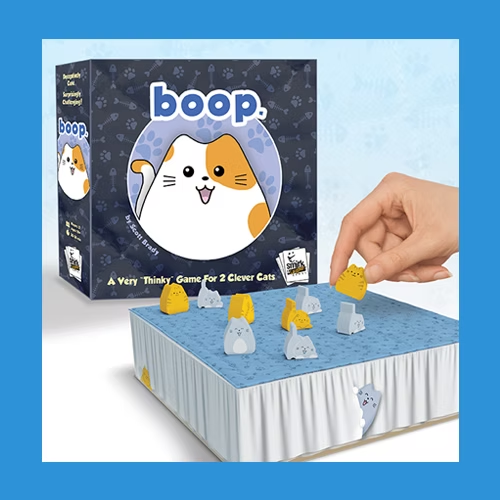
Image taken from Smirk & Dagger’s website
Don’t let the aggressively cute theme fool you. boop. is a razor-sharp abstract game that sinks its claws in fast. Every time you place a kitten, it “boops” neighbouring kittens one space away, creating a constant spatial shuffle that feels equal parts tactical puzzle and chaotic cat herding. Get three kittens in a row and they graduate into big ol’ cats. Get three cats in a row and you win. Simple, right?
Wrong.
What I loved most was the game grows naturally. It’s not like chess where you engage in a war of attrition, slowly whittling down the opposing army’s strength while trying to preserve your own units. The game starts as a blank canvas, and only your supiror kitty placement will prove you the victor. Every move feels meaningful, and the swingy endgame is deliciously tense as the bed becomes littered with cats and both players are participaing in a dangerous dance to see who manages to trap the other player first. The more I played it, the more hidden depth I saw in boop.
4 – The Guild of Merchant Explorers
Designers: Matthew Dunstan & Brett J. Gilbert | Publisher: AEG

Image taken from AEG’s website
The Guild of Merchant Explorers is basically a solo map exploration game. Flip a card, place cubes on matching terrain, expand your network, score stuff, then wipe your board and do it again. Each round you also gain a unique power card, which gives the next round a bit of fresh fun.
The Guild of Merchant Explorers is low-interaction and pretty heads-down, which kind of makes it a perfect async BGA game. Everyone is lost in their own little map and the person with the most points wins, but the puzzle is engaging, which makes this worth playing. If you’re like me, and you’ve grown a bit tired of Kingdom Builder (or Bigfoot just keeps beating you), The Guild of Merchant Explorers scratches a lot of the same itch. I’ve read that the physical board game can be a bit fiddly with all the tracking and resetting, but that’s not an issue on BGA!
3 – Captain Flip
Designers: Remo Conzadori & Paolo Mori | Publisher: PlayPunk

Image taken from PlayPunk’s website
Captain Flip is the kind of breezy filler that immediately turns into “okay, but let’s play again.” Draw a tile from the bag, decide whether to keep it as is, or flip it for the random other side, and slot it into your crew tableau for points. But once flipped, no take-backsies.
Every turn is awash in push-your-luck temptation. Do you take the known mediocre pirate or flip and pray for glory? Then you place them on your board and try to make it work. Captain Flip is quick, the art is funny, and somehow the decisions stay interesting across repeated plays. I keep thinking I’m done with it, but my heart just keeps asking for one more game. Just one more and I’ll be satisfied, I promise!
2 – Tag Team
Designers: Gricha German & Corentin Lebrat | Publisher: Scorpion Masqué

Image taken from Scorpion Masque’s website
This one blind sided me. Tag Team is an auto-battler crossed with a deck-builder. You pick two fighters, each with their own mini-deck, mash them together, and unleash them in a battle where you have no control. Your cards flip one by one while you pray your attacks trigger before your opponent’s defences do. You never shuffle your deck, you just add one card each round, then during the combat phase, there are no decisions to make. You flip over the cards and do what they say, it’s all preprogrammed.
The magic here is the learning loop: round one, you have no idea what order your opponent has put into their deck. Round two, you start planning counters, their second card was an attack, so you should slot a defence card to counter it. In round three, you’re fully working towards synergies and tweaking your own deck, hoping to outthink your opponent. It’s fast, clever, and most importantly exciting. When you and your opponent are at critical health, you watch the cards flip and just hope you placed your defence card in the right spot to hit them with a critical counter-attack.
I will say that one of my opponents said that Tag Team was about as exciting as playing War, and I can see where she’s coming from. I disagree, I think Tag Team is as brilliant as the 2023 Kennerspiel des Jahres winner Challengers, but I get where she’s coming from.
1 – Coffee Rush
Designer: Euijin Han | Publisher: Korea Boardgames

Image Credit: Fabrício Santos @Fanage via BGG
The #1 spot goes to the game that surprised me the most: Coffee Rush. It’s essentially an order-fulfillment puzzle where players scramble around an ingredient grid trying to gather the ingredients for drinks before the queue plunges into chaos. The game starts as a calm “latte, in 3 turns please.” but it quickly becomes a frantic race as the orders pile up, and the pressure starts to ring in your ears.
I’ll have a full review of Coffee Rush soon, because I’ve been enjoying it so much, but what makes it shine is probably my own bias. I used to work in kitchens, and seeing the orders pile up and tick down as you frantically knock them down makes my soul sing. You’re constantly managing tiny crises, every planned route is one step too long, and every upgrade you unlock feels like a restocked station. For a game that was so easy to grasp, it delivered a satisfying amount of brain burn. If I had this on my table, I’d almost certainly impose a timer to really make it feel stressful, just like working in a café.
Those have been my 5 favourite new to me games on BGA this year. Are you looking for a new player on BGA? Hit me up with a game invite anytime. I can’t promise brilliance, but I can guarantee enthusiasm, and I take my turns at least 3 times a day.


0 Comments