2025 was a big year for “new to me” games on BoardGameGeek, and the data tells a fun story about what people were actually adding to their shelves. Instead of pure sales charts, or arbitrarily locking down the conversation to games released in the last calendar year, today I’m going to take a look at games had the most number of BGG users logging as owned, which I think says a lot about long-term buzz and staying power.
This top 5 is ordered by how many BGG users marked each game as “owned” during 2025, not how many copies sold in stores. Think of it as “the games most adopted by hobbyists who log their collections” rather than a definitive “best-selling at retail” list.
5 – Ark Nova – 13,091 new owners
Ark Nova continues to climb as the heavyweight darling of modern strategy games, with its interesting action selection river, resource management, and multi-use cards, it’s a big, beloved game whose intricate web of tags, prerequisites, and long-term planning absolutely sings for some players…and completely falls flat for others. Others like me. I’m the wet blanket who doesn’t like Ark Nova, okay!?
Ark Nova lands in the same bucket as Terraforming Mars. The sheer number of card restrictions creates too many feel-bad moments when a cool card shows up that just doesn’t work with my current position. That mismatch between “what the deck is dealing” and “what the map and tableau actually support” can feel like hitting red lights three turns in a row. Experts will happily tell me that is part of the challenge, but I can’t help but feel bad regardless. And with my limited hobby time, I’d rather play games that make me feel happy. Still, I respect Ark Nova for it’s success
4 – 7 Wonders Duel – 13,519 new owners
7 Wonders has long been an entry point into the hobby, famous for handling up to seven players in half an hour. Unfortunately, its built-in two-player mode leans on a dummy city that turns every turn into a juggling act of managing a ghost hand, explicitly hate-drafting your opponent, and really wishing you had just played a proper 2 player game.
7 Wonders Duelfixes that by being unapologetically, perfectly two-player. The pyramid-style card display creates constant tension between taking what you need but revealing something juicy for your opponent. The dual threat of sudden military or science victories keeps every decision sharp. Drafting wonders at the start gives each game a different rhythm, especially because extra-turn wonders let you “break” the normal flow in very satisfying ways.
It’s quite impressive that over a decade later, and 7 Wonders Duel is still topping the sales charts. With 2 expansions, and a Lord of the Rings reimplementation, 7 Wonders Duel has proved it has the staying power and longevity to earn a permanent spot on my Top 10 Games of All Time.
3 – Heat: Pedal to the Metal – 14,210 new owners
Heat: Pedal to the Metal takes classic car racing and fuses it with fast, accessible deck-building, letting players manage gears, speed cards, and “heat” as the currency of risk. Each round, your gear dictates how many cards you can play, letting you go faster and faster, but the corners demand careful speed checks, lest you go careening off the rails. The slipstreaming mechanic does a good job of keeping the pack bunched together, so races feel tense right up to the last turn. The way heat cards clog your hand when you push too far, yet are also the resource that lets you take those big swings, is a brilliant bit of hand management that explains why board game fans have latched onto it so fiercely.
Having only played Heat once so far, I still prefer the earlier cycling game Flamme Rouge, from the same design duo, where the positional puzzle feels a bit cleaner and the deck is less cluttered. That said, Heat absolutely nails the fantasy of dropping a gear and perfectly executing a controlled drift around a tight bend. We’ve all had that experience at the grocery store, right?
2 – Wingspan – 17,874 new owners
Years after its 2019 release,Wingspanis still adding more new BGG owners per year than almost every other modern hobby game, and I suspect more than any other game on this list, for this new owners number to be dramatically lower than reality. I’m constantly meeting new people who have picked up a copy of Wingspan because they played it and loved it, only for them to ask “what’s a Board Game Geek” when I ask for their profile name.
It’s not hard to see why Wingspan is so popular. Its production is undeniably stunning, especially if you’re used to the super cheap family games that we used to shove into cupboards. The linen-finished cards feel great to hold, the pastel eggs are an immediate talking point, the beautiful bird illustrations and the welcoming gameplay, with its simple core actions slowly blossoming into a satisfying combo by game end, it’s no wonder why Wingspan continues to win over new players.
1 – Sky Team – 25,002 new owners
Sky Team soared to the top of the new-owners chart with a massive lead, driven by a wave of acclaim, including major awards like the Spiel des Jahres and Golden Geek honours for cooperative and two-player play. It is a strictly two-player co-op where two pilots work together via silent dice placement to land a commercial airliner safely.
Each round represents 1,000 feet of descent as you and your partner roll dice, then, without talking about numbers, slot them into your shared cockpit to balance the plane, manage speed, deploy flaps and landing gear, and avoid traffic. That combination of tight communication limits, escalating tension, and scenario variety has turned Sky Team into a go-to two-player game for a lot of people. Ironically, despite its popularity, I have yet to sit down and play it. The person I’m most likely to play it with owns it, and has already played it 30 times with his partner, so his craving for it has been satisfied. One day I’m sure I’ll get a chance to play it, but even without my input, Sky Team sits at the top of this list as the game the most BGG users were excited to bring into their home in 2025.
Over the past few years, we’ve seen an explosion in the “cozy” genre in all forms of media. Books, shows, video games, and yes, board games. But it always makes me wonder what exactly makes a board game cozy? It’s obviously not just about ease of play, but I think it’s more about the feeling the game evokes. Cozy games are gentle on competition and rich in atmosphere. They tell you to slow down, do something perhaps inane, but satisfying, and soak in the pleasure in small decisions. You’re not fighting to survive or building a bustling metropolis; you’re farming, sorting, and enjoying the process of play itself.
A cozy board game often pairs calm themes, such as gardens, quilts, villages, and lantern festivals, with accessible mechanics that let conversation flow as easily as the gameplay. I also think they remove some of the consequences, so you can revel in your own creation, instead of worrying about trying to come out ahead.
With that established, here are five board games that capture that warm, comforting spirit. These are games perfect for rainy days, quiet evenings, or when you simply want to have a moment of peace at the game table.
1. A Gentle Rain
By Kevin Wilson, published by Mondo Games | Full Review
If meditation could take cardboard form, it might look like A Gentle Rain. In this solo or cooperative tile-laying game, you’re creating a tranquil pond surrounded by blooming flowers. There’s no score to chase or opponent to outsmart—just the soft rhythm of placing tiles and watching the scene unfold. Each tile shows a mix of flowers and water patterns, and your task is simply to align them in harmony.
The beauty of The Gentle Rain lies in its simplicity. The game is as much about the act of playing as it is about the result. The sound of tiles clicking together feels almost therapeutic, and completing the circle of blooms brings a quiet satisfaction. It’s a rare game that can calm your mind while still offering a gentle puzzle to engage it.
2. Dorfromantik: The Board Game
By Michael Palm and Lukas Zach, published by Pegasus Spiele
Despite my gripes with Dorfromantik: The Duel, Dorfromantik does manage to capture the charm of building a pastoral landscape one tile at a time. You and your friends collaborate to construct a patchwork of rivers, forests, and villages, trying to fulfill small goals without breaking the natural flow of the map. The art is charming, the turns are breezy, and there’s never a sense of pressure. You won’t agonize over a tile placement, and for some players, that’s exactly the appeal. It’s a game that asks very little of you, other than to sit back, relax, and build a countryside for half an hour.
There’s a touch of comfort in Dorfromantik’s balance between order and chance. It rewards planning, but a bad tile draw doesn’t feel like a punishment. You can just toss it onto the other end of your landscape and hope it’ll come into play later. And as an added bonus, by the end you’ve created a serene countryside. It’s the perfect companion for tea, soft music, and unhurried conversation.
3. Patchwork
By Uwe Rosenberg, published by Lookout Games
Few games embody “cozy competition” like Patchwork. While the theme is about trying to create a patchwork quilt, the economy, the theme is mearly window dressing. Mechanically, you’re managing two resources, buttons and time, to acquire eclectic polyomino tiles, and setting them onto your board until you’ve patchworked your way to the end of the game.
Despite its puzzly nature, Patchwork feels homely. The theme of quilting, paired with the subtle satisfaction of fitting the perfect pieces into its place, makes every session feel like you’re curled up on the couch crafting. The game is simple enough for newcomers but deep enough to keep seasoned players engaged. It’s one I use to introduce the board game hobby to anyone who enjoys crafting, quilting, or knitting.
4. Lanterns: The Harvest Festival
By Christopher Chung, published by Renegade Game Studios
Lanterns: The Harvest Festival turns tile-laying into a celebration of light and beauty. Players take turns placing lake tiles adorned with floating lanterns into a shared tableau, and everyone at the table receives coloured lantern cards based on how the tile is oriented. This shared reward system keeps the tone friendly, even as you subtly compete for the best colour combinations to craft sets and score points.
What makes Lanterns cozy is its elegance and positive player interaction. It’s a communal experience where your opponents’ moves bring you gifts. If you’re looking for a game that radiates charm and encourages quiet appreciation, Lanterns is a perfect fit.
5. Flamecraft
By Manny Vega, published by Cardboard Alchemy | Full Review
At first glance, Flamecraft dazzles with its whimsy: dragons in aprons brewing coffee, baking bread, and enchanting local shops. But beneath its adorable art lies a smooth as silk worker-placement game where players act as “Flamekeepers,” guiding artisan dragons to bolster the town’s businesses.
Flamecraft is cozy in every sense. Its theme and artwork radiates warmth and imagination, while the gameplay rewards kindness and collaboration as much as competition, as you’ll all be unlocking stronger action placements for each other. It’s a feast for the eyes as those adorable little dragons, each with their own unique name dot the board, and the vignettes on the shop cards are full of whimsy and charm.
Final Thoughts
Cozy games remind us that play doesn’t always need tension to be fulfilling. Whether you’re placing tiles in a pond, building a countryside, or helping dragons bake pastries, these experiences invite calm, connection, and creativity. In a world that moves too fast, it’s nice to have games that encourage you to slow down and simply enjoy being at the table.
Every December, I scroll through everyone else’s “Best Games of the Year” lists and feel the familiar pang of jealousy. By the time those posts go up, I’ve generally only played about five titles from the current year. Hardly enough to stand shoulder-to-shoulder with anyone publishing a “Best of 2025” list.
But that’s okay. Being a little behind the curve has its perks. At the time of writing this post, I’ve played 110 games that were published in 2024, giving me some insight of which games actually endured the hype cycle. So instead of churning through hot takes, these are the five 2024 releases that climbed the BGG ranks this year, and what I think about them.
5 – Arcs
Arcs is one of those games where the praise and the frustration can live side by side. Designed by Cole Wehrle and published by Leder Games, it’s a tactical, trick-taking-adjacent space opera where everything, from its world-building to its action economy, feels flawlessly engineered.
As I wrote back in my review, “Arcs is a masterpiece. It’s a game bursting with so much variety, discovery, and depth, all crafted meticulously by designer Cole Wehrle. Every mechanic feels intentional… There isn’t an ounce of unnecessary bloat.”
And yet, “It’s just a shame that I don’t like playing it.”
For players who love being on their toes, Arcs is exhilarating. It’s a game about seizing fleeting opportunities, pulling the exact right lever at the exact right time, and surviving long enough to pivot when the galaxy turns against you. The Blighted Reach campaign expands the base game into a three-act space saga that rewards mastery and table commitment in equal measure.
But for players like me, who crave structure and control, Arcs can feel like being handcuffed to the whims of the deck. I don’t like being cut off from core actions entirely, just because I was dealt a hand of manoeuvre cards. And yes, I know there are ways to subvert a bad hand, it still feels more frustrating than anything else to me. But even I can’t deny how deftly it integrates narrative, tactics, and high-stakes decisions. Arcs might not be the game for me, but it’s unquestionably one of 2024’s best and boldest designs.
4 – Harmonies
Harmonies deserves all the praise it’s gotten so far. It’s a gorgeous spatial puzzle that’s both soothing and surprisingly demanding.
Designed by Johan Benvenuto and published by Libellud, Harmonies quickly became a darling of the 2024 awards circuit, earning a Spiel des Jahres recommendation and winning the Golden Geek Medium Game of the Year. It’s easy to see why.
To oversimplify it, imagine Azul crossed with Cascadia. In Harmonies, you’re building a landscape on your personal player board, creating harmonious habitats for the various animals that could call your board home. Each turn, you draft and place terrain discs, plan for animal patterns, and try to make everything fit together in a natural rhythm.
The cadence of Harmonies is calm, and the puzzle is satisfying. It’s a short, beautiful game that rewards smart drafting and spatial planning without really punishing you for mistakes, aside from lost opportunities. And while there’s precious little player interaction, that calm independence is part of its charm. Harmonies is a game for quiet concentration and tactile joy, not cutthroat competition.
3 – The Lord of the Rings: Duel for Middle-earth
I love 7 Wonders Duel, much more than the full 7-player game from which it spun off from. And that’s the bias I held which I approached The Lord of the Rings: Duel for Middle-earth, the streamlined reimagining from Antoine Bauza and Bruno Cathala.
Like 7 Wonders Duel, it’s a two-player card drafting duel, but this time, one player controls the Free Peoples of Middle Earth while the other commands Sauron’s forces. Victory can come from destroying or capturing the ring, conquering every region, or earning the allegiance of all six races.
Comparing it to 7 Wonders Duel, Duel for Middle-earth has been smoothed to a polished stone. All the wonky rules have been shaved off, everything is easier, and you’re able to calculate the cose for everything with a glance. The result is an elegant, fast-playing experience that evokes the tension of the original while being even more accessible.
That polish, however, comes at a cost. Because the game is smoother, it feels flatter. There’s less texture and depth to grab onto. You lose some of the crunchy engine-building and wild swings in resource costs that make 7 Wonders Duel so replayable. And yet, when my partner and I played Duel for Middle-earth for the first time, we learned it and knocked out two games within an hour and immediately wanted a third. It doesn’t replace 7 Wonders Duel for me, but it does make for an attractive 2 player game that I’d be happy to introduce to almost anyone.
2 – Slay the Spire: The Board Game
Slay the Spire needs no introduction to digital-deckbuilding fans, but the tabletop adaptation from Contention Games was one of the year’s most quietly ambitious triumphs. It managed to translate the tension, rhythm, and roguelike loop of the video game without feeling like a diluted knock off.
Each player pilots a unique character through a branching path of combats, upgrades, and relics, all while managing card efficiency and risk. What impressed me most isn’t that it’s accurate, but that designers Gary Dworetsky, Anthony Giovannetti, and Casey Yano understood the core of the game and didn’t just copy the digital game one for one. They took it as inspiration and created something that works amazingly well on the table without a computer managing the math in the background.
I convinced a friend to buy this for her husband, and while she was initially hesitant because she wasn’t a fan of coop games, they told me they played it almost a dozen times in the weeks that followed. And now both of them have been playing the app too, which inspired me to continue my ascension challenge as well.
1 – SETI: Search for Extraterrestrial Intelligence
There’s something poetic about a game that looks to the cosmos for answers, topping this list. SETI: Search for Extraterrestrial Intelligence, designed by Tomáš Holek and published by Czech Games Edition, became one of the most celebrated euros of 2024.
Given scant resources in this tight economy, you’re asked to stretch your actions as far as possible to build an engine to propel yourself to victory. There’s a lot going on in SETI, but the best thing I can say is that we finished our first play at a local café, and one of our players immediately bought a copy on the spot.
Any euro that inspires instant ownership speaks volumes. SETI strikes a rare balance of brain-burning complexity and cool, thematic immersion. You’re not just moving cubes to score points; you’re sending probes out to the far reaches of our solar system, chasing the thrill of discovery itself. And that spark, the sense of optimism and wonder that pushes people to explore the limits of space, well, I think we all need a bit more of that in our lives.
2024 was a great year for games, and these 5 games really showcase the strength of the board game hobby. Now that 2026 is here, I can’t wait to get started on all the great games that came out in 2025!
Another year has passed, and like everyone else, I like to spend a lot of December thinking about the year that’s just passed. This is my version of a “Year in review” that you’ll see many reviewers and media folk engage in. My real problem is that I just don’t play very many games the year they’re released. It’s a byproduct of being a cave dwelling Canadian troglodyte and never going to any of the conventions, the hot new games just don’t show up on my FLGS shelves. And the rate at which I acquire games is pretty suppressed when I’m not at conventions soliciting for review copies to plaster all over social media.
Sidebar, I do get quite annoyed whenever a convention ends and my social media is flooded with media folk posting their hauls and not disclosing which of the games they got for free. It creates an illusion that is detrimental to many people’s mental health, and I wish we as an industry were better.
Getting off that soap box, I’m going to list my top 10 new to be board games that I played in real life this year. I’ll have a separate list for my favourite BGA games next week, so look forward to that!
10 – Argent: The Consortium
Designer: Trey Chambers | Publisher: Level 99 Games | Full Review
Argent: The Consortium is a worker placement game from 2015 that remains interesting and engaging. I acquired solely because of how much I’ve enjoyed Level 99 Games other games, and this design holds up. It’s not perfect by any stretch, but I’ll be damned if this isn’t the most interesting, interactive, and clever worker placement game I’ve played in a long time. It’s the kind of game that ruins other worker placement games for you. I did post a full review of Argent last month if you’re interested in reading more about it!
9 – Tragedy Looper
Designer: BakaFire | Publisher: Zman Games
Another old game I picked up from a math trade, Tragedy Looper is a deduction game from 2011. Leaning hard into the anime aesthetic, Tragedy Looper actually really reminds me of Higurashi: When They Cry, which, may or may not be a turn-off for those who have encountered that series before. In Tragedy Looper, the players are tasked with preventing a tragedy from happening, but they don’t know exactly what the tragedy is, or what roles each of the characters are playing. When a loss condition occurs, the game resets, or loops, and players only have a certain number of loops to figure out what exactly is going on, and prevent the mastermind from fulfilling his dark desires.
What kept this game on mine (and many others) shelf of shame for so long, is that it’s a one vs. many type of game. One player needs to play the mastermind, who gets access to all the information right away, and is trying to bait and trick the players into wasting their precious loops as they figure out the details of what’s going on around them. It’s a much less interesting role, as the mastermind, as you sit in your own head and play your cards, then watch the other players discuss and plot for 10 minute rounds.
But the deduction is exciting. Making unexpected moves to throw make the players think someone is a killer when they’re not, playing cards as a feint to try and get the players to waste their turns countering your cards makes for a unique experience. As far as one vs many games go, I’d MUCH rather play another game of Tragedy Looper than something like Beast
8 – Things in Rings
Designer: Peter C. Hayward | Publisher: AllPlay
Q: What does a belt, moose, flamingo, and a guitar all have in common?
Things in Rings is Venn diagram the board game. With 3 rope circles on the table, creating a triple Venn diagram, the mastermind is given 3 cards dictating the rules for each of the circles. Players are dealt a hand of cards, and need to play cards in or out of the diagram depending on the rules they don’t even know. After playing a card, the mastermind either confirms or reject the placement, moving the card to the correct location if necessary. If the player was correct, they continue placing cards, if incorrect, they draw a new one to replenish their hands. The player first to play all their cards is the winner.
Explaining it like that is a pretty boring description, but trust me when I say that Things in Rings is a brilliant little party game. The Dr. Seuss style art by Snow Conrad does a lot to help the whimsy of the game, but placing cards and watching the mastermind give you a thumbs up or down is delightful. Your mind will stretch and bend trying to figure out what sets of cards have in common with each other, until the game comes to an end and the answers are revealed, usually to uproarious laughter. Things in Rings is a delight, and I can’t wait to play it again.
Reiner Knizia has had a long and storied career, but one of his latest games, Rebirth was a delightful surprise. Generally when I see Knizia’s name on the box, my brain immediately goes to the brown and beige of Ra and Tigris and Euphrates, but Rebirth is awash in colour. Lush verdant landscapes invite the players to start plonking down their tokens, claiming parcels of land for themselves.
Rebirth is easy to learn and play, yet makes you feel like your decisions matter. Building clusters of your tokens is important, as is getting to the most valuable spaces first. Rebirth was a delightful euro surprise that I’d be happy to introduce to my mom, who loves games, but can’t internalize too many complex rules.
6 – Cockroach Poker
Designer: Jacques Zeimet | Publisher: Drei Magier Spiele | Full Review
I bought Cockroach Poker on a bit of a whim, and kind of fell in love with it. Rife with double think and bluffing, Cockroach Poker excels at building tension and creating exciting moments and opportunities for smack talk.
I get that not everyone likes pure bluffing games, but Cockroach Poker has zero stakes. Every game I’ve played has ended in gut busting laughter, and it’s over pretty quickly. It’s the perfect pub game.
5 – Trio
Designer: Kaya Miyano | Publisher: Happy Camper | Full Review
Originally published as Nana, I’ve described Trio as Go Fish mixed with Memory, but it works so well! Everyone gets a hand of cards, and then more are dealt face down on the table. On your turn you can ask any player to reveal their highest or lowest card, and after they do so, you can ask any player to do the same, or you can flip one of the face down cards. If you reveal a match, you get to do a third action. If all 3 revealed cards are a match, you take them as a trio! Take 3 trios and you win the game!
Another fast and accessible game, Trio is delightful in its simplicity. Also, the elation you feel when you manage to reveal 3 cards of the same number, reminds me a bit of Skull. All the information getting revealed is available to all players, so as the game goes on, presumably people are building mental maps of who has what. Unless you’re me and are just playing based on vibes.
While I’m not the most keen on deduction games, Bomb Busters was an explosive surprise this year. A cooperative game in which players are trying to snip all the wires except the bad ones. The trick is you don’t know which wire is which when you’re snipping!
The production on Bomb Busters is delightful, mostly the art by Dominque Ferland. It’s a charming and evokes the same feelings as Minesweeper. It’s the kind of game that once it clicks, you can play it over and over and over until either you finish all 66 missions, or the sun comes up. Whichever happens first.
3 – SETI: Search for Extraterrestrial Intelligence
Designer: Tomáš Holek | Publisher: Czech Games Edition
Man, talk about a game rocketing up the BGG top games list. I didn’t realize it until I was making this list, but it’s already reached #27, making it the highest ranked game that came out in 2024.
SETI: Search for Extraterrestrial Intelligence is a complex euro game about searching the galaxy and beyond for alien life forms. Given scant resources in this tight economy, you’re asked to stretch your actions as far as possible to build an engine to propel yourself to victory. There’s a lot going on in SETI, but I think the best thing I can really say about it is that we initially played it at our local board game café, and just as we were counting up the final score, one of our players stood up, walked over to the shelf, and grabbed a copy to buy, right there on the spot.
Since that day, she’s played it over a dozen times and is falling in love with it more and more with every play. If that isn’t a glowing recommendation, then I don’t know what is.
2 – The Gang
Designers: John Cooper, Kory Heath | Publisher: KOSMOS | Full Review
Talking about games that got a bit overplayed, The Gang went over like gang busters when it hit our table early this year. There was a four or five week stretch where this was getting pulled out before or after every game. In The Gang, players are cooperatively trying to sort out their poker hands. With limited information, players take a chip from the centre of the table indicating where they think they’ll end up in the hierarchy when all the cards are revealed. It was easy to play, and even easier to say “just one more round” again and again.
I always need to caveat that none of our players had any real experience with Poker, so this was largely an exercise in a bunch of rookies playing in the mud. But boy did we have fun doing it!
1 – Fit to Print
Designer: Peter McPherson | Publisher: Flatout Games
I’ve always said I love real time games, and Fit to Print is no different. As editors of the local newspaper, you’re all scrambling to assemble articles, photographs, and ads to earn the most points and money over a hectic weekend. First, you’ll scramble to pick up tiles and put them on your desk, then when you think you have all the tiles you need, you’ll move into the layout phase, where you place the tiles onto your board. If you overcommitted, extra articles that don’t make it onto the paper lose you points, and if you have huge swaths of empty space, you guessed it, lost points. Also, you have to have variety, so ensuring all no columns to pictures touch each other is pivotal in making a good-looking newspaper.
I find Fit to Print easier to play than Galaxy Trucker, while still retaining the same feeling of panic and stress that I relish. It doesn’t result in the uproarious laughter that Galaxy Trucker delivers, but it’s still a really fun game. I love playing it, and the Ian O’Toole art makes it a delight to look at.
Alright, that’s enough from this cave-dwelling Canadian troglodyte. What was YOUR favourite new-to-you game this year? Tell me in the comments so I can immediately convince myself I “need” it and then spend January explaining to my family why another box showed up on the doorstep.
In addition to my weekly Wednesday night group, I almost always have a small mass of async BGA games ticking away in the background. Normally, I prefer to learn games in real life. Something about touching cardboard and making eye contact with the person whose plans I’m about to ruin. Also, not having a computer to run the rules for me makes me internalize the rules much better. But this year I’ve been much more willing to join various random games pitched by the more active members of the BGA groups I’m a member of. Specifically, The Nerd Shelves and Board Game Hot Takes, where there’s a bustling little community of BGA degenerates constantly offering up new games for public participation.
And they succeeded, because I ended up playing enough new titles to make a whole top 5 list of standouts. Let’s get into it.
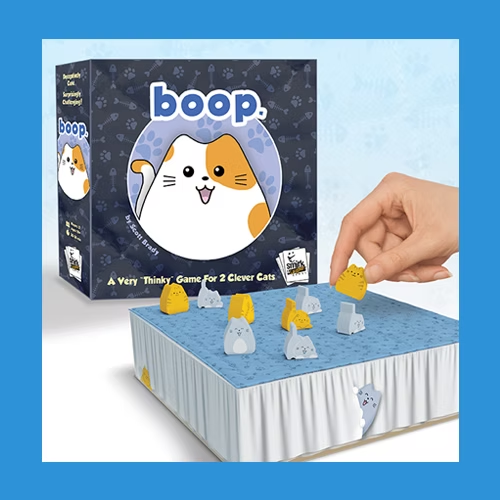
5 – boop.
Designer: Scott Brady | Publisher: Smirk & Dagger Games
Don’t let the aggressively cute theme fool you. boop. is a razor-sharp abstract game that sinks its claws in fast. Every time you place a kitten, it “boops” neighbouring kittens one space away, creating a constant spatial shuffle that feels equal parts tactical puzzle and chaotic cat herding. Get three kittens in a row and they graduate into big ol’ cats. Get three cats in a row and you win. Simple, right?
Wrong.
What I loved most was the game grows naturally. It’s not like chess where you engage in a war of attrition, slowly whittling down the opposing army’s strength while trying to preserve your own units. The game starts as a blank canvas, and only your supiror kitty placement will prove you the victor. Every move feels meaningful, and the swingy endgame is deliciously tense as the bed becomes littered with cats and both players are participaing in a dangerous dance to see who manages to trap the other player first. The more I played it, the more hidden depth I saw in boop.
4 – The Guild of Merchant Explorers
Designers: Matthew Dunstan & Brett J. Gilbert | Publisher: AEG
The Guild of Merchant Explorers is basically a solo map exploration game. Flip a card, place cubes on matching terrain, expand your network, score stuff, then wipe your board and do it again. Each round you also gain a unique power card, which gives the next round a bit of fresh fun.
The Guild of Merchant Explorers is low-interaction and pretty heads-down, which kind of makes it a perfect async BGA game. Everyone is lost in their own little map and the person with the most points wins, but the puzzle is engaging, which makes this worth playing. If you’re like me, and you’ve grown a bit tired of Kingdom Builder (or Bigfoot just keeps beating you), The Guild of Merchant Explorers scratches a lot of the same itch. I’ve read that the physical board game can be a bit fiddly with all the tracking and resetting, but that’s not an issue on BGA!
3 – Captain Flip
Designers: Remo Conzadori & Paolo Mori | Publisher: PlayPunk
Captain Flip is the kind of breezy filler that immediately turns into “okay, but let’s play again.” Draw a tile from the bag, decide whether to keep it as is, or flip it for the random other side, and slot it into your crew tableau for points. But once flipped, no take-backsies.
Every turn is awash in push-your-luck temptation. Do you take the known mediocre pirate or flip and pray for glory? Then you place them on your board and try to make it work. Captain Flip is quick, the art is funny, and somehow the decisions stay interesting across repeated plays. I keep thinking I’m done with it, but my heart just keeps asking for one more game. Just one more and I’ll be satisfied, I promise!
2 – Tag Team
Designers: Gricha German & Corentin Lebrat | Publisher: Scorpion Masqué
This one blind sided me. Tag Team is an auto-battler crossed with a deck-builder. You pick two fighters, each with their own mini-deck, mash them together, and unleash them in a battle where you have no control. Your cards flip one by one while you pray your attacks trigger before your opponent’s defences do. You never shuffle your deck, you just add one card each round, then during the combat phase, there are no decisions to make. You flip over the cards and do what they say, it’s all preprogrammed.
The magic here is the learning loop: round one, you have no idea what order your opponent has put into their deck. Round two, you start planning counters, their second card was an attack, so you should slot a defence card to counter it. In round three, you’re fully working towards synergies and tweaking your own deck, hoping to outthink your opponent. It’s fast, clever, and most importantly exciting. When you and your opponent are at critical health, you watch the cards flip and just hope you placed your defence card in the right spot to hit them with a critical counter-attack.
I will say that one of my opponents said that Tag Team was about as exciting as playing War, and I can see where she’s coming from. I disagree, I think Tag Team is as brilliant as the 2023 Kennerspiel des Jahres winner Challengers, but I get where she’s coming from.
1 – Coffee Rush
Designer: Euijin Han | Publisher: Korea Boardgames
The #1 spot goes to the game that surprised me the most: Coffee Rush. It’s essentially an order-fulfillment puzzle where players scramble around an ingredient grid trying to gather the ingredients for drinks before the queue plunges into chaos. The game starts as a calm “latte, in 3 turns please.” but it quickly becomes a frantic race as the orders pile up, and the pressure starts to ring in your ears.
I’ll have a full review of Coffee Rush soon, because I’ve been enjoying it so much, but what makes it shine is probably my own bias. I used to work in kitchens, and seeing the orders pile up and tick down as you frantically knock them down makes my soul sing. You’re constantly managing tiny crises, every planned route is one step too long, and every upgrade you unlock feels like a restocked station. For a game that was so easy to grasp, it delivered a satisfying amount of brain burn. If I had this on my table, I’d almost certainly impose a timer to really make it feel stressful, just like working in a café.
Those have been my 5 favourite new to me games on BGA this year. Are you looking for a new player on BGA? Hit me up with a game invite anytime. I can’t promise brilliance, but I can guarantee enthusiasm, and I take my turns at least 3 times a day.
Board Game Hot Takes is one of my favourite board game podcasts. The casual banter the guys share make it feel like you’re part of a group, just chatting about your favourite games. In their most recent episode, #277, they dig into the games they’ve ranked on Board Game Geek, and I thought it would be fun to piggy-back on their conversation and explore my own BGG ratings. But before I get into that, I want to send a sincere congratulation to the BGHT crew on reaching 1 million downloads!
Now, if you’ve spent any time on Board Game Geek, you’re well acquainted with the BGG rankings. Every registered member can rank any game from a 1 to a 10. I’ve talked before on why I don’t include numbers in my reviews, as I don’t think a single number can really capture my experience with a game. But today, I’m diving straight into that subjective mess, how I actually rate games on BGG, and why those numbers matter a bit more than I want to admit.
So to set the stage, here’s my stats. On BGG, I’ve ranked 628 games, and my average rating is a 7.06. At this point in my board game career, I’ve gotten pretty good at knowing what I’m probably going to enjoy. So most of the games that catch my attention and make their way to my table will end up being around a 6 or 7 on my enjoyment scale. It’s pretty rare that a game has me excited and interested enough to play, but to fall utterly flat on its execution. Rare, but not impossible.
While I don’t take the BGG ratings of a game as the gospel truth, I do think there is some value in crowd-sourced rankings. So in this post, I’m digging into the full 1–10 spectrum. What BGG says those ratings actually mean, how I personally use them, and which games end up in each of those categories. Grab a coffee, brace yourself for some self-reflection, and let’s talk numbers.
1 – Defies description of a game. You won’t catch me dead playing this. Clearly broken.
0 Games – 0%
At the very bottom sits the rarest of ratings: the game so broken, incomplete, or objectionable that it barely qualifies as a game at all. A 1 isn’t just bad, it’s the kind of experience you keep on your list only to remind yourself what went wrong.
Perhaps a little controversial here, but I actually haven’t rated any games as a 1. With the criteria of getting a 1 being “defies description of a game”, I would have to play something so arbitrary and pointless, that I’d rather sit on the couch and learn to knit while the rest of my group plays a 1-rated game. When that game shows up, I’ll come back and edit this entry.
2 – Extremely annoying game, won’t play this ever again.
2 games – .32%
A 2 is reserved for the experiences that waver between disappointing into downright aggravating. These are the games that spark frustration and rage rather than fun. These are the games that make me swear off gaming, and inspire me to find new friends.
The only 2 games that I’ve ranked as a 2 are Cards Against Humanity, and Munchkin (the Christmas edition, but that’s a stand-in for the entirety of the Munchkin product line). Cards Against Humanity is a garbage game about putting the most absurd and inappropriate card from your hand into a sentence to make you feel like you were being clever. You know a game is bad when you can just draw the top card from the deck, and it happens to win more often than not.
Munchkin on the other hand, has a tiny bit more respect. I find Muchkin painful to play, as inevitably, one player makes it to 8 or 9 points, then everyone spends their cards hurting everyone else. I’ve had games take over an hour to complete, with players just getting close to the goal, only to be denied. It’s the anthesis of fun.
3 – Likely won’t play this again, although I could be convinced. Bad.
2 Games – .32%
Here lie the games that simply miss the mark. They’re not rage-inducing, but they’re firmly in the “no thanks” category. A 3 signals something fundamentally unenjoyable. Like the 2’s, I only have 2 games rated as a 3. Exploding Kittens, and Monopoly.
Exploding Kittens I can kind of get it’s popularity. It’s easy to play with kids, reminicient of Old Maid, but actually playing it feels like an exercise in tedium. Monopoly, on the other hand… Well, I don’t think I need to get into why I rated it a 3.
4 – Not so good, it doesn’t get me but could be talked into it on occasion.
8 Games – 1.27%
A 4 represents that the slow transition from actively avoiding playing a game, to a tepid, reluctant acceptance. These games aren’t as unplayable as the ones that came before, but I’d need a strong, convincing argument to get me to sit down and play these games.
I’m not going to go over every game in each category, but perhaps the most controversial 4’s I have are Grand Austria Hotel, and Ticket to Ride.
Ticket to Ride I’ve already reviewed ranted about, but Grand Austria Hotel is a fairly beloved game, so what gives? I find the dice drafting to be an exercise in frustration. Add to that the downtime between turns as the game can be fairly AP prone, I find the acronym for Grand Austria Hotel sums up my thoughts nicely; GAH!
Rounding out my 4’s are games like New Bedford, Nox, Phase 10, and Pokémon Master Trainer.
5 – Average game, slightly boring, take it or leave it.
35 Games – 5.57%
A 5 game is the equivalent of a shrug. Perhaps perfectly serviceable, usually slightly boring, and often easily forgotten, these are games I will never seek out, but then again, probably wouldn’t protest too loudly if someone else is really keen to play them. A 5 is usually a dumping ground if I recognize a game has some interesting elements, but don’t jibe with me personally.
Some notable 5’s include Dorfomantik: The Duel, Isle of Trains: All Aboard, Disney Villainous, and Rajas of the Ganges. My most controversial 5’s are Terraforming Mars, Great Western Trail, Maracaibo, and Teotihuacan. I’m sure you can argue that my distaste for these games is a skill issue, and if that’s the case, then I invite you to start your own blog and call me out for my bad opinions.
6 – Ok game, some fun or challenge at least, will play sporadically if in the right mood.
100 games – 15.92%
The 6 rating marks the beginning of genuinely enjoyable territory. These games offer some entertainment or challenge, even if they don’t call to me consistently. They’re usually pleasant, albeit perhaps a bit fragile. Maybe requiring the right group, and are generally not that memorable.
A lot of euro games end up here. Some classics like The Pillars of the Earth, Amerigo, Catan, Finca, Machi Koro, and Viceroy. Some more contemporary 6’s for me include the likes of Deus, In the Hall of the Mountain King, or Ex Libris. Most of these are games that had a cool or had an interesting hook, but nothing that made me want to come back.
Speaking of games that made me not want to come back, other popular games languishing in my 6’s include Beast, Arcs, Terra Mystica (and by extension Age of Innovation, and The Quacks of Quedlingburg. These are games that others love, but I simply did not enjoy. To each their own, I suppose!
7 – Good game, usually willing to play.
220 Games – 35.03%
The 7 category is where my “average enjoyable game” lives. These games are reliably fun, worth returning to, and generally welcome on the table. Not masterpieces, but certainly good gaming.
Some games that I like more than the majority of BGG users include such titles as Bananagrams, Stalk Exchange, Roll to the Top, Dinosaur Tea Party, Bag of Chips, and even the classic Scrabble.
Some beloved games that I’ve slotted into the 7 space are heavy-hitters such as Ark Nova, Gloomhaven, Twilight Struggle, Root, Mage Knight, and Tzolkin.
Really, the majority of games in this category are just good games, but ones that didn’t really blow my socks off. Marco Polo is intresting, but I find a tiny bit tedious to play, I recognize that Ra is a great game, but I fundamentally dislike auction games, so here it sits. Architects of the West Kingdom, Raiders of the North Sea, Lorenzo il Magniflco, Trajan, Yokohama, Tapestry, Dominion, King of Tokyo, Spirit Island, and Clank! A Deck Building Game are all examples of games that I enjoyed, but I don’t feel the need or urge to play them again, let alone rush out and buy a copy to own.
8 – Very good game. I like to play. Probably I’ll suggest it and will never turn down a game.
201 Games – 32.01%
An 8 is where my enthusiasm starts to shine through. These are games I’m genuinely excited to bring to the table. They’re often polished, engaging, replayable, and memorable. I won’t t always choose them over my absolute favourites, but I’ll happily recommend them and would rarely turn down a play.
The upper crust of the 8’s are the ones that just barely squeak onto my top 100 games of all time lists. These are games I’d be happy to own, or would easily recommend to others as great games to give as a gift, or just to play.
Some of the most popular games that I’ve ranked as an 8 include the eminently popular Wingspan, Azul, andCarcassone. Some heavy games that hit my 8 rating include A Feast for Odin, SETI: Search for Exterrestrial Intelligence, Pax Pamir, The Gallerist, Voidfall, and Eclipse: New Dawn for the Galaxy.
A 9 is reserved for the games that spark joy almost every time I think about them. They’re often the ones I suggest first, that I never feel done exploring, and remind me why the board game hobby is so great in the first place. When a 9 hits this level, it’s a great day. This includes Pandemic, 7 Wonders, Scythe, Patchwork, The Castles of Burgundy, Jaipur, and Brass: Birmingham.
10 – Outstanding. Always want to play and expect this will never change.
14 Games – 2.23%
A question the BGHT crew posed was “What seperates a 9 from a 10?” For me, the 10 is the pinnacle. The games that feel complete, magical, and endlessly rewarding. These are the experiences that define me. Whether it’s emotional, elegant, epic, or simply perfect for me, a 10 is more than a favourite, it’s a masterpiece that reaffirms why I love board games at all. These are the games that make me salivate when I think about them, and my heart race while I’m playing them.
Paperback Adventures was Slay the Spire crossed the deck building in a way that just excites me. Bullet❤️ had that spark that reminded me that board games can still really excite me. Galaxy Trucker never fails to make me full-belly laugh. Isle of Skye,Istanbul, and Race for the Galaxy are endlessly replayable. And then, of course, there’s Food Chain Magnate, which was the perfect combination of mechanics and theme that burrowed its way into my psyche and never ever let go.
Conclusion
In the end, BGG ratings aren’t about winning some invisible argument about what a game should score. They’re about capturing how a game made me feel when I played it. What surprised me, what fusturated me, and which games stuck in my brain as I laid in bed after an exhillrating game night.
My 1s and 10s and everything in between aren’t objective truths. They’re breadcrumbs marking where I’ve been in this hobby and where I found joy and pain along the way. They subjective opinions that tell my story. If you’ve struggled with rating games for fear of ‘giving the wrong rating’, don’t stress about it. If there’s one thing I’ve realized during this exercise is that the numbers change. Let me know where you agree with me in the comments below, and if you disagree with some of my takes, then that’s okay too.